Sunday, February 22, 2015

Iguanodon: Prehistoric Animal of the Week

This week we will be looking at one of the most famous and well-studied dinosaurs of all time.  Let's make way for Iguanodon bernissartensis!

Iguanodon was a plant-eating dinosaur that lived in what is now Belgium, during the early Cretaceous period, about 125 million years ago.  Adults measured roughly thirty three feet long from beak to tail, and would have been comfortable walking on all fours or as bipeds.  Iguanodon belongs to the ornithopod group of dinosaurs, and was closely related to Tenontosaurus and Mantellisaurus.(which even used to be considered a kind of Iguanodon)  Iguanodon also has family ties with the later duck-billed hadrosaurs, like Parasaurolophus and Edmontosaurus.

Iguanodon bernissartensis life reconstruction by Christopher DiPiazza.

Iguanodon was one of the first ever dinosaurs to be recognized by science.  Humans had been discovering dinosaurs for thousands of years prior, of course, but Iguanodon, along with Megalosaurus, was one of the first to actually be called a "dinosaur".  This happened back in 1822 when scientist, Gideon Mantell and his wife, Marry Ann, discovered some very strange fossilized teeth, in England.  Upon closely examining these teeth, Dr. Mantell realized that they were very similar to the teeth of modern iguanas, which are mostly plant-eaters, and concluded that the fossil teeth he had found must have come from some sort of gigantic, plant-eating reptile.  A few years later, several large bones, including limbs, part of a tail, and some vertebrae were discovered which were determined to be from the same kind of animal.  The animal was named, Iguanodon, which translates to "Iguana Tooth", because of...the teeth...and the fact that they looked like iguana teeth.  

Iguanodon skeletal mount.

The first reconstructions of Iguanodon were based off of very little information, and were largely inspired by modern reptiles, mainly lizards and crocodiles.  Life-sized models of this version of Iguanodon, were erected, along with several other prehistoric creatures, in the gardens of the Crystal Palace, in England.  The palace, itself, has since burned down, but the statues in the garden are still standing, and can be visited still today.  It is a cool reminder of what our perception of dinosaurs used to be when we first started studying them.  


Iguanodon statues in the gardens of the Crystal Palace in England. Note how lizard-like they are and the fact that they have nose horns instead of thumb spikes.

Okay, ready for some confusing information?  Good.  That whole story about Iguanodon being discovered way back in the 1800s and being made into a beautiful statue...may not have been based on the dinosaur that we call Iguanodon today.  If you were paying attention, you may have noticed that that story took place in England, but I said that Iguanodon lived in what is now Belgium!  What's the deal?  You see, since those discoveries in the 1800s, many dinosaurs similar to those specimens have been found, and they were all named Iguanodon.  Pretty soon there were lots different species of large, plant-eating dinosaurs from all over Europe and even parts of the United States with the genus name, Iguanodon.  It wasn't until recently that these dinosaurs were re-evaluated and divided into different genus where necessary.  By the end of it, only one species remained standing with the official genus name, Iguanodon.  It was the most completely known, and it was from Belgium.  The original bones from England were likely from a different dinosaur, we know call Mantellisaurus.  (Which was very similar to the animal we now call Iguanodon, but not the same.)  Thanks, taxonomy!

Mantellisaurus life reconstruction by Christopher DiPiazza.  Note that the arms are much shorter than the legs.  Iguanodon had much longer arms proportionally.
Since the 1800s, many more specimens of Iguanodon and its close relatives have been discovered, giving us a more accurate depiction of what it would have looked like when alive.  We now know it would have had a beak in the front of its snout and could have easily walked on its hind legs if it wanted to.  The front limbs were long, about 75% the length of its hind legs, and each armed with five digits on the hands, the first of which, took the form of a broad spike-like claw.  This spike was originally incorrectly believed to be a nose horn, which can be seen on the Crystal Palace statues.  Scientists are still not completely sure as to what these claws were for, but they could have been for defense against predators, or possibly for fighting within the species for dominance.  The next three digits on the hand were broad and strong, and would have had claws similar to hooves on them.  These fingers were good for supporting the weight of the animal's body when walking on all fours, and were not very flexible.  The fifth, and last digit on each hand, jutted out to the side more and was flexible, possibly for manipulating food.  

skeletal mount of an Iguanodon hand.
Iguanodon would have had stiff tendons running down its back and tail, which would have made its spine rigid.  It would not have been able to run very fast on its hind legs, and would have been reduced to little more than a power-walk when on all fours. (despite what a certain Disney movie might have you believe)  

There is no real evidence that would suggest Iguanodon would have lived in groups when alive, unlike its later cousins, the hadrosaurs.  At one time, fossil sites yielding multiple Iguanodon skeletons caused some people to think they could have been social, but it was later discovered that those skeletons, despite being in the same area, were from animals that each died years apart from one another.  They most likely had each washed down a river and ended up at the bottom of the same lake.

That is all for this week!  As always feel free to comment below or on our facebook page!

References

Carpenter, K.; Ishida, Y. (2010). "Early and "Middle" Cretaceous Iguanodonts in Time and Space" (PDF). Journal of Iberian Geology 36(2): 145–164.

Naish, Darren; Martill, David M. (2001). "Ornithopod dinosaurs".Dinosaurs of the Isle of Wight. London: The Palaeontological Association. pp. 60–132. ISBN 0-901702-72-2.

Norman, David B. (2004). "Basal Iguanodontia". In Weishampel, D. B.; Dodson, P.; Osmólska, H. The Dinosauria (2nd ed.). Berkeley: University of California Press. pp. 413–437.

Paul, Gregory S. (2008). "A revised taxonomy of the iguanodont dinosaur genera and species". Cretaceous Research 29 (2): 192–216.

Sues, Hans-Dieter (1997). "European Dinosaur Hunters". In James Orville Farlow and M. K. Brett-Surman (eds.). The Complete Dinosaur. Bloomington: Indiana University Press. p. 14.

Monday, February 2, 2015

Cryolophosaurus: Prehistoric Animal of the Week

Here in New Jersey we are going through a bitter cold week.  When I walk outside, the air hurts my face.  The air shouldn't be hurting my face.  This week we will be looking at a dinosaur which was discovered in one of the coldest places on earth, enter Cryolophosaurus ellioti.

Cryolophosaurus lived in what is now Antarctica during the early Jurassic Period, between 194 and 188 million years ago.  It measured about twenty one feet long from snout to tail and ate meat.  When alive, Cryolophosaurus was likely the largest predator in its environment.  

Cryolophosaurus ellioti feeding on a young prosauropod, Glacialisaurus.  The bones of Glacialisaurus were found in the same area as those of Cryolophosaurus.  Restoration by Christopher DiPiazza.

One of the things that makes Cryolophosaurus interesting is its unique crest.  Lots of theropods had crests, but almost all of these run parallel to the dinosaur's skull.  Cryolophosaurus was the only known theropod with a crest that runs perpendicular to the rest of the skull, resembling a sort of hairdo.  Lots of people say it looks like it has a pompadour, like women wore in the 18th century.  I think it looks more like Miley Cyrus last year. (You can even hear her pretending to be a Cryolophosaurus in this short video!)  The genus name, Cryolophosaurus, translates to "Ice Crested Lizard-Reptile" in reference to this crest, and to where its bones were discovered...which has lots of ice from what I hear.

Skeletal mount of Cryolophosaurus on display in a Museum in Japan.  Most of the skeleton is based on guesswork, including most of the snout.  This model has a very deep snout, likely inspired by AllosaurusCryolophosaurus may not have looked like that, however.

The biggest misconception about this dinosaur comes from the fact that it was discovered in Antarctica.  Because of this you can find scores of life restorations of it on the internet completely covered in thick feathers to keep warm as it trudges across a wasteland of ice and snow.  The thing that some people forget is that the land mass we now call Antarctica was a lot closer to the equator during the early Jurassic so the environment Cryolophosaurus was living in was significantly warmer than it is today.  In fact, thanks to many plant fossils that were also unearthed from the same rock formations, we know Cryolophosaurus' world was mostly forest and likely was not that cold.  During certain parts of the year it did become chilly, sure, but not nearly as frigid as Antarctica is today.  Also remember that during the early Jurassic, Antarctica was attached to Australia, India, Africa and South America, in a giant supercontinent, called Gondwana.  So even when it did become colder, there was nothing stopping dinosaurs like Cryolophosaurus from migrating north where it was warmer.  There is no evidence suggesting this, but there is a lot we don't know about Cryolophosaurus in general.  We can, however, deduct that it wasn't likely a dinosaur specially adapted for a frigid ice world.

This is a photo of the skull material of Cryolophosaurus that was actually found.  As you can see, most of the snout is missing so the exact shape of this dinosaur's head is a mystery for now.

There is debate as to where exactly Cryolophosaurus lands on the theropod family tree.  At first it was believed to be some sort of early ceratosaur, closely related to Coelophysis and Dilophosaurus.  Ceratosaurs were very successful during the Triassic and Jurassic, and it did sport a crest, like many ceratosaurs did.  Later, upon closer inspections of the few bones paleontologists had to work with, Cryolophosaurus was then thought to be a very early member of the more advanced group of theropods, called tetanurans.  Tetanurans include all theropods beyond the ceratosaurs, basically.  This includes many famous dinosaurs like Megalosaurus, Spinosaurus, Allosaurus, Tyrannosaurus, Velociraptor, Sturthiomimus, Therizinosaurus, all modern birds...and all the dinosaurs in between them.   Cryolophosaurus would have been the earliest known member of this group of dinosaurs.  If more material is discovered and studied, however, views on Cryolophosaurus' identity may change again.

That is all for this week!  As always feel free to comment below or on our facebook page!

References

Chandler, M.A.; Rind, D.; Ruedy, R. (1992). "Pangaean climate during the Early Jurassic: GCM simulations and the sedimentary record of paleoclimate". Geological Society of America Bulletin 104 (5): 543–559. doi:10.1130/0016-7606(1992)104<0543:PCDTEJ>2.3.CO;2.

Hammer, W. R.; Hickerson, W. J. (1994). "A Crested Theropod Dinosaur from Antarctica". Science 264 (5160): 828–830. doi:10.1126/science.264.5160.828. PMID 17794724

Smith, N.D.; Makovicky, P.J.; Hammer, W.R.; Currie, P.J. (2007). "Osteology of Cryolophosaurus ellioti (Dinosauria: Theropoda) from the Early Jurassic of Antarctica and implications for early theropod evolution". Zoological Journal of the Linnean Society 151 (2): 377–421. doi:10.1111/j.1096-3642.2007.00325.x.

 Smith, N. D.; Makovicky, P.J.; Pol, D.; Hammer, W.R.; Currie, P.J. (2007). "The Dinosaurs of the Early Jurassic Hanson Formation of the Central Transantarctic Mountains: Phylogenetic Review and Synthesis". US Geological Survey Open-File Report 2007 (1047srp003). doi:10.3133/of2007-1047.srp003.

Sunday, January 25, 2015

Mussaurus: Prehistoric Animal of the Week

Today's prehistoric animal of the week was requested by a fan through our comments section.  Let's check out Mussaurus patagonicus!  Mussaurus was a plant-eating dinosaur that lived in what is now Argentina during the Late Triassic Period, 215 million years ago.  Its name translates to "Mouse Lizard/Reptile" because the first skeletons found of of this dinosaur were only about eight inches long.

Mussaurus patagonicus baby investigating a stonefly as it gets sniffed by mom. Reconstruction by Christopher DiPiazza.

You might be thinking "Wow!  Mussaurus was probably the smallest non-avian dinosaur ever discovered!" and for a while that is what a lot of people believed, even though many paleontologists believed that these skeletons were most likely from babies and could have grown to be much larger.  In fact, the original Mussaurus skeletons were actually found near nests with eggshells, further supporting the hypothesis that they were only babies.  It wasn't until 2013 that a research paper was published, describing some bones found from the same area as the tiny skeletons  that were concluded to be from adult Mussaurus, which were indeed, much larger.  Judging by the bones that were discovered, which included limbs, hips and a tail,  these adults would have measured roughly ten feet long from snout to tail.


Photograph of the bones from an adult Mussasaurus' left foot from the 2013 paper in the Journal of Vertebrate Paleontology.

Baby Mussaurus had proportionally huge heads with large eye sockets and short snouts.  This is a common trait for the babies of vertebrate animals, especially those that exhibit parental care.  A large head with large eyes traditionally make an animal appear cute to its parents.  That way the parents will more likely want to care for the baby and would be less likely to abandon it...or eat it, especially when it is being a pain in the tush.  I'm serious.  There is a very good reason why baby animals (including human kids) are cutest at the neediest parts of their lives.  This cute appearance has even been selectively bred into domestic dog and cat breeds to persist through adulthood.  My Yorkshire Terrier is a senior at thirteen years old and still looks pretty much the same as when he was a puppy.  It's not because he is small.  It's because he has a proportionally big noggin and big eyes.  Ever wonder why small dog breeds are more commonly spoiled by their owners than large breeds?  It's because they look like babies and their owners treat them as such.


He aint even sorry.

So what kind of dinosaur was Mussaurus?  How do we know the fragmentary remains from the adult specimens go with the strangely-proportioned small specimens?  The answer becomes clear when we search the fossil record and find other examples of more completely known parent and baby dinosaur discoveries.  Last year I reviewed a dinosaur called Massospondylus.  Massospondylus is known from nesting sites that include adults with nests of babies and eggs.  The baby Massospondylus look very similar to baby Mussaurus in heir proportions and they both even walked on all fours.  The adult Massospondylus, however had much longer necks, proportionally small heads, and walked on their hind legs.  The specimens that were determined to be adult Mussaurus show the same features.  Mussaurus was a kind of prosauropod dinosaur, like Massospondylus.  The more famous, Plateosaurus, was also an example of a prosauropod.  Prosauropods were generally plant-eating dinosaurs that were most common during the Triassic and the beginning of the Jurassic Periods.  Paleontologists believe that some prosauropods were the ancestors of the later, gigantic sauropods, like Apatosaurus.

Skeleton of a baby Mussaurus.

 That is all for this week!  As always feel free to comment below or on our facebook page.   Also don't forget to follow us on instagram.  (I put some seriously cool stuff on there!)

References

Alejandro Otero & Diego Pol (2013) Postcranial anatomy and phylogenetic relationships of Mussaurus patagonicus (Dinosauria, Sauropodomorpha), Journal of Vertebrate Paleontology, 33:5, 1138-1168

Mussaurus." In: Dodson, Peter & Britt, Brooks & Carpenter, Kenneth & Forster, Catherine A. & Gillette, David D. & Norell, Mark A. & Olshevsky, George & Parrish, J. Michael & Weishampel, David B. The Age of Dinosaurs. Publications International, LTD. p. 40. 


Wednesday, January 21, 2015

Rough Sketches fo Finished Paintings: Part 4

It's time for another addition of Rough Sketches to Finished Paintings!  .

As you may know, I try to get as much professional input on my paintings as possible during the process of making them in order for them to be as scientifically accurate as possible.  The first painting we will be looking at the creation of is my Euoplocephalus!  I was lucky enough to get help from paleontologist, and ankylosaurid expert, Dr. Victoria Arbour.  Below is the first sketch I sent her.


I was glad to hear from her that it looked perfect except for a few things.  Even though all the armor for Euoplocephalus tutti has never been found, judging by other related specimens, it is logical to assume it had armor running down the length of the tail right up to the club and that I should add that in my sketch.  Also the claws on the hind legs were more blunt than what I had originally drawn.  Below is my modified sketch.


finished piece
 Next is the original sketch for my Redonda Formation painting!  For this I employed the help of paleontologist, Donald Price, whom I have the pleasure of excavating Triassic fossils with this past summer in New Mexico.  Donald is currently studying phytosaurs, like Redondasaurus.


 His only suggestion would be to re-arrange the scutes (armor plates) on the Redondasaurus's back.  We are still not completely sure as to how these scutes were arranged in life, but Donald is getting some interesting ideas from his work with them.  What i changed it to reflects one of his hypotheses.

finished piece

 Next is my painting of Aquilops, the tiny ceratopsian dinosaur recently described last month.  I got the input of the paleontologist who lead the paper on this lovely little critter, Dr. Andy Farke!


His only suggestion after looking at my sketch was to make the head a little bit deeper and shorten the hallux (inside claw) on the foot.  So I did.  You may also notice that my depiction of this dinosaur does not have any of those elongated quill-like structures, commonly depicted on ceratopsians (especially small ones) in paleo-art.  These structures have only been found in one specimen of the ceratopsian family tree (Psittacosaurus, not a direct ancestor of Aquillops or any of the large ceratopsians) and appears to have been a display adaptation.  That being said it is not likely that EVERY ceratopsian that ever lived had the same structures for display. 

finished piece
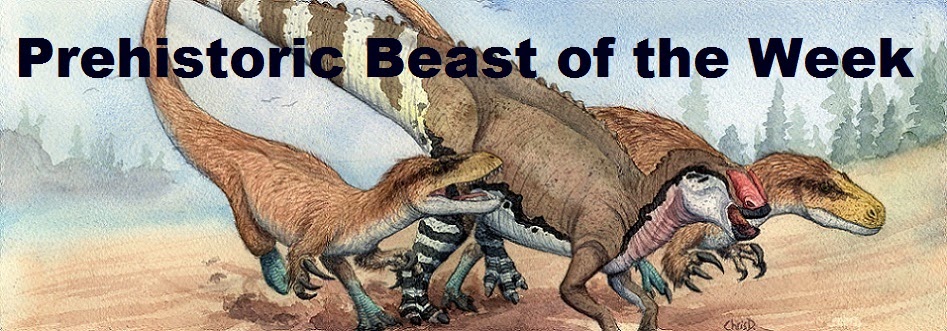
Finally let's check out the making of JerseyBoysHuntDinosaurs.com's new banner!  This is a remake of a piece that I did years ago of a pair of Dryptosaurus hunting a hadrosaur on the shores of what is now New Jersey millions of years ago, during the Late Cretaceous.  I asked for the help of paleontologist, Steve Brusatte, with this one.  Dr. Brusatte is one of the paleontologists who authored the most recent scientific paper about Dryptosaurus.


Amazingly enough, the first sketch was good!  Dryptosaurus likely had three fingers on each hand, although some artists depict it as having two which could have been true, as well.  It's arms were not as long as those of some earlier tyrannosauroids, like Eotyrannus or Guanlong, but they were certainly proportionally longer than those of its larger tyrannosaurid cousins like Tyrannosaurus.  Dryptosaurus' first claw on each hand was also proportionally huge.  You can see the rest of this painting's progression below.  If you follow me on instagram, however, you would have seen these way ahead of time!


finished piece

That is all for this week!  If you have not already feel free to check out the first, second, and third installments of this feature while you are here.  Thank you again to all the experts willing to lend their inputs for the sake of scientific illustration!

Thursday, January 15, 2015

Interview with Paleontologist: Victoria Arbour

 Today we have an interview with paleontologist, Victoria Arbour, from the University of Alberta!  

VA: I am interested in the evolution and palaeobiology of ankylosaurid dinosaurs. Ankylosaurids are large, armoured, herbivorous dinosaurs with club-like tails. Derived ankylosaurids are present in the Late Cretaceous of North America and Asia, but many more species have been described from Asia than North America. Is this difference in diversity real or just apparent? Are North American ankylosaurids more diverse than we currently recognize? How do we differentiate between taphonomic, intraspecific, and interspecific variation in these unusual dinosaurs? I am also interested in the application of digital modeling to problems in vertebrate paleontology.


Question 1: Who did you admire growing up? 

VA: People who worked hard and gave freely of their time to others!

Question 2: At what age did you get inspired to pursue a career in paleontology? 

VA: Unfortunately I don't have a cool "Ah ha!" moment where I decided to study palaeontology. My interest in dinosaurs goes as far back as I can remember.

Question 4: What was your favorite dinosaur growing up?  What dinosaur is your favorite now?

VA: It's so hard to pick just one, you guys! I know that some of the first dinosaur toys I ever picked out for myself were the Carnegie Parasaurolophus and Euoplocephalus figures, and I've found drawings of ankylosaurs, sauropods, pachycephalosaurs and theropods from when I must have been 5 or 6.

Euoplocephalus reconstrucion by Christopher DiPiazza.

Question 5: You have been getting some attention recently because of your awesome work with the ankylosaur, Euplocephalus, and some of its relatives.  How did your involvement with this specific project come about?  Did you choose it or did it choose you?

VA: I chose it. It stems from my MSc work on ankylosaur tail clubbing biomechanics, which in turn was inspired by looking at illustrations in a kid's book one day and wondering if anyone had actually studied the plausibility of tail-clubbing behaviour. As I was working on CT scanning and modeling tail club impacts, I was struck by the variety of shapes and sizes just in tail clubs alone, and I was curious if there were any taxonomic differences in stuff referred to Euoplocephalus (which formed the bulk of my study specimens given my location in Alberta and their relative abundance) that might have biomechanical or behavioural implications. That was too big a project to do for my MSc, so for my PhD I decided to look at revising all known ankylosaurids. Understanding intraspecific vs interspecific variation was therefore super important, and since Euoplocephalus sensu lato had the largest sample size it made sense to look closely at Euoplocephalus first in order to understand variation. I am very glad that my supervisor (Phil Currie) is supportive of his grad students developing their own projects from scratch, because you're going to need to do that when you're on your own, so you may as well start early!

Victoria poses with Pinacosaurus at the Palaeontological Institute in Moscow.

Question 6: I found your publication particularly interesting because more recently it seems like lumping different kinds of dinosaurs into one species (whether they be seen as different sexes or growth stages) has been more common (dare I say trendy?) than splitting them.  In your personal opinion are there any other kinds of prehistoric animals you think were likely more than one species or even genus?

VA: I don't think the best way to refer to it is as a trend – what's happening is that now we have lots of information that wasn't available to previous generations of palaeontologists, and that's helping us understanding taxonomic diversity in a different way. We are building on the knowledge of the people who came before us. One thing I am a little bit leery of is something I like to call the "Highlander Rule", ie. there can only be one ______ per ecosystem, but I also think if you were to, say, be naming your twelfth large ankylosaurid from the same time and place, then maybe you should think really carefully about that. I think taxonomic revision is an ongoing process, since we are always getting better data on ontogeny, stratigraphy, and other sources of variation.

Victoria's diagram summing up the differences between the four genus of ankylosaurids that had previously been lumped into one.  (and before that were actually different genus originally)

Question 7: Paleontology is such a diverse field these days involving many disciplines.  What advice would you give to an aspiring paleontologist today?

VA: This is a good but tough question! I would give some of the standard advice to study both geology and biology and to make sure your math is pretty strong, since more and more work is moving towards numerical analyses. If I could go back in time and magically add several extra hours into the day, I would have taken a few more stats courses. That being said, I did have to dredge up my calculus for some of my biomechanics work.
You should spend a lot of time honing your writing skills. I think there can be a perception that writing is only for the arts disciplines, but most of what I do each day is write! Writing is the primary way that we communicate scientific ideas to each other, through papers, book chapters, and social media. Writing is also what will secure your financial livelihood...if you can't write a compelling grant or scholarship proposal, you probably won't get money for your research.
I also think having a diversity of interests and backgrounds is the best way to find new ways of attacking palaeontological problems, so I think you should just generally be curious about lots of things, read a lot, and be open to questions coming from weird places.

Question 8: Going to college these days and then on to grad school has become a daunting task.  Many people are unaware of how long it takes to make it to the finish line.  The rewards are great, but what would you say to someone pursuing professional studies after college?

VA: Go into palaeontology (or any other specialized field) with your eyes wide open. It is really hard to get a job in academia (where most palaeontologists probably want to wind up). I think we all have this idea that it's a meritocracy and anyone who works hard will get their 'reward', and that is not necessarily the reality. You DO need to work really hard, in order to be a desirable candidate for a job, but 'fit' has a lot to do with getting hired, and you don't really have any control over that. If you want to be a palaeontologist, you should do it! But you should educate yourself about the reality of getting hired, and what you need to accomplish in order to get there. If your university is doing any job-related seminars or workshops, go and listen to what the people doing the hiring have to say!

Given that, these are some things to consider if you want to pursue a career as an academic palaeontologist:

1) You absolutely must publish papers. Science or Nature papers help, but a strong publication record without a paper in one of those journals will still stand out, it seems.

2) You need to be an active member of the palaeontological community – give talks at conferences, meet people at museums and forge partnerships and collaborations, and be a good colleague.

3) Field experience can be really important for some kinds of positions like museum curatorships or more field-based university programs. (Also, it is fun!)

4) Teach some kind of anatomy or comparative anatomy course while you are in grad school, or take a cadaver dissection course. Anatomy jobs are difficult to fill in many universities because of the move away from anatomy and zoology towards molecular biology/genetics in recent years. I was specifically told that I got an interview for an Assistant Professor position at one university both because of my strong publication record, but also because they screened out anyone who had never taught a comparative anatomy/human anatomy course.

5) Be tenacious. If you want an academic job, you might need to stick things out for a pretty long time. I don't know many people who have landed a permanent academic job right out of their PhD, so you need to be willing to keep doing postdocs and contract work for 2-10 years after you finish your PhD.

Perhaps more importantly: do things that you enjoy that you think enrich you as a person. You're going to be in grad school for a while, and you shouldn't feel like those are 'lost' years after the fact, especially if it's hard to find a job afterwards. You might also find that you like some aspects of palaeontology better than others, or have an aptitude for things outside the traditional research track. Maybe you're a really good artist, or science communicator, or teacher, or technical writer. Maybe you're really good at writing code, or want to get into science policy. But you won't know those things if you don't give yourself the space to do them or consider them.

Question 9: What was or is your favorite research project?  What are some of your current projects?

I have really enjoyed all of my research projects, even the ones that were hard or that took a long time to finish. Right now I am working on publishing my PhD thesis that I defended last December. It's a big revision of the phylogenetic relationships of the ankylosaurids, and there are some cool things that I should not talk about yet! But stay tuned if you like ankylosaurs!

unting dinosaurs in the Mongolian Gobi in 2010. I didn't find any ankylosaurs, but she did find this cool Argali sheep skull.

Question 10: Jurassic Park and Land Before Time (opposite ends of the spectrum I know) were the movies I remember as a kid that fueled my passion for dinosaurs.  What was your most memorable movie, book or TV program that inspired you with regards to paleontology?

VA: We must be about the same age, because those were two pretty important movies from my childhood as well. This is another one where it's hard to pick just one inspiration, so I'll give you a little trip down nostalgia lane and mention a few Big Deal dinosaur media from my childhood. There was an A&E series hosted by Walter Cronkite, titled simply "Dinosaur!" (http://www.youtube.com/watch?v=kxcx8s0OYnY) that I taped and watched over and over and over again. When I was five or six a Dinamation arena exhibit came through my hometown and was a Big Deal that I remember quite vividly (even now, I am excited when I come across old Dinamation robots still roaring away in museums). The January 1993 issue of National Geographic had a huge piece all about dinosaurs, with wonderful illustrations by John Gurche. I was also the perfect age to be blown away by James Gurney's art in the original Dinotopia book.

Question 11: I remember meeting my first professional paleontologist.  Do you remember the first paleontologist you ever met?  Were you a nervous wreck?

VA: I think it might have been Phil Currie while I was doing my undergrad at Dalhousie University! I grew up in Nova Scotia and we didn't have a lot of dinosaur palaeontologists around. (Plus, how do we define professional palaeontologist?) I was nervous in the sense that I was meeting someone who is pretty well known and I didn't want to look stupid, but I don't recall being any more nervous than I would have been around any professor or person of authority. I don't think you should be nervous to talk to palaeontologists!

Some of the eyes keeping watch on Victoria while she works out problems in ankylosaur taxonomy.  Adults can have dinosaur toys too!

Question 12: Dinosaurs and the animals that lived at the same time as them were amazing creatures.  Why do you feel they continue to fascinate us?

VA: I think some social scientist needs to do a proper study investigating why people are interested in dinosaurs. I would love to know! I think what I like about palaeontology is the imaginative aspects of it – you get to exercise your creative brain all the time in trying to reconstruct the appearances, behaviours, and ecosystems of prehistoric organisms. The challenge when doing palaeontology as a science is then to find ways to rigorously test what your imagination produces.

Question 13: What is your favorite time period?

VA: Most of my work has been on animals from the Late Cretaceous. Back in Nova Scotia we have lots of Permian and Triassic rocks, and I have found the recent advances in understanding the origin of dinosaurs and the incredible diversity of non-dinosaurian dinosauromorphs to be tremendously exciting. If I didn't work on dinosaurs, I think I'd be most interested in moving into Permian synapsids, because those guys are neat and weird and don't get enough love.

Question 14: Is there anything else you would like to share about yourself?  What hobbies do you have (not necessarily paleo-related).

VA: Palaeontology occupies most of my brain and most of my day, so my non-research activities tend to still be related to palaeontology in some way. For the last year and a half I was pretty heavily involved with the production and delivery of the Dino 101 massive open online course (https://www.coursera.org/course/dino101, next offering is in September 2014 for anyone who is interested!), and I tend to do a number of science outreach activities each year like talks, visits to museums or libraries, and tours of our lab spaces on campus. I also write a blog about my research projects, museum travels, and other palaeo ephemera (pseudoplocephalus.blogspot.com). Finally, if you're interested in following along with the research coming out of the University of Alberta, you should like the Dino Lab at the University of Alberta on Facebook (www.facebook.com/DinoLabUAlberta) – I post links to papers by folks from our lab, field photos, prep lab updates, etc., a couple of times a week. Thanks for inviting me onto your blog!

Dinosaur 101 office hours at the Alberta Dinosaur Museum.  Come on, people!  Who has time for hangovers when there is a paleontologist to consult with?!

Monday, January 12, 2015

Eotyrannus: Prehistoric Animal of the Week

This week we will be taking a look at a predator that once called the United Kingdom home.  Check out Eotyrannus lengi Eotyrannus came from what is now called the Isle of Wight, off of the southern coast of England, during the Early Cretaceous, about 130 million years ago.  When alive it would have coexisted with several other dinosaurs known from that place and time, like Baryonyx, Hypsilophodon, and MantellisaurusEotyrannus is known from a partial skeleton from an individual that would have measured roughly thirteen feet long from snout to tail, but this specimen may be a juvenile and could have grown to be larger.  The genus name, Eotyrannus, translates to "dawn tyrant" because at the time of its discovery, Eotyrannus was the earliest known member of the tyrannosauroid superfamily. (Much older tyrannosauroids have been discovered since.)

Eotyrannus life reconstruction by Christopher DiPiazza.

Eotyrannus was a tyrannosauroid which means that it belongs to the same group as large, two-fingered tyrannosaurids like Tyrannosaurus, Tarbosaurus, Lythronax, and Teratophoneus.  Like them, it had curved, serrated teeth with a D-shaped cross section.  However, Eotyrannus was more basal than these later predators and shares more in common with its closer, more basal relatives, like Dryptosaurus and Guanlong. Like them it had proportionally longer arms with three fingers on each hand, each tipped with a curved claw.  It also had long legs and overall gracile build, implying that it was a fast runner.

Eotyrannus hand claw on display at the Isle of Wight Museum.  Photo courtesy of Marc Vincent.

When alive, Eotyrannus may have relied on its speed and probably specialized in hunting smaller prey, like the small ornithopod dinosaurs it shared its habitat with.  It also would have needed to use its speed and agility to avoid the larger predators it coexisted with like Baryonyx, the spinosaurid, and Neovenator, the allosauroid.

Eotyrannus lower jaw fragment and tooth on display at the Isle of Wight Museum.  Photo Courtesy of Marc Vincent.

That is all for this week!  As always feel free to comment below or on our facebook page!

References

Brusatte, S. L. and Benson, R. B. J. and Norell, M. A. (2011) The Anatomy of Dryptosaurus aquilunguis (Dinosauria: Theropoda) and a Review of its Tyrannosauroid Affinities. American Museum Novitates, 3717 . pp. 1-53. ISSN 0003-0082

 Loewen, M.A.; Irmis, R.B.; Sertich, J.J.W.; Currie, P. J.; Sampson, S. D. (2013). Evans, David C, ed. "Tyrant Dinosaur Evolution Tracks the Rise and Fall of Late Cretaceous Oceans". PLoS ONE 8 (11): e79420. doi:10.1371/journal.pone.0079420.

Hutt, S., Naish, D., Martill, D.M., Barker, M.J., and Newbery, P. (2001). "A preliminary account of a new tyrannosauroid theropod from the Wessex Formation (Cretaceous) of southern England." Cretaceous Research, 22: 227–242.