Monday, April 4, 2016

Yutyrannus: Beast of the Week

This week we will be checking out a dinosaur that changed the way we think about feathers.  Enter Yutyrannus huali!

Yutyrannus was a meat-eating dinosaur that lived in what is now China during the early Cretaceous Period, about 125 million years ago.  It was large, measuring about thirty feet from snout to tail as an adult.  The genus name, Yutyrannus, translates to "Feathered Tyrant" because, as you're about to learn, it had feathers!

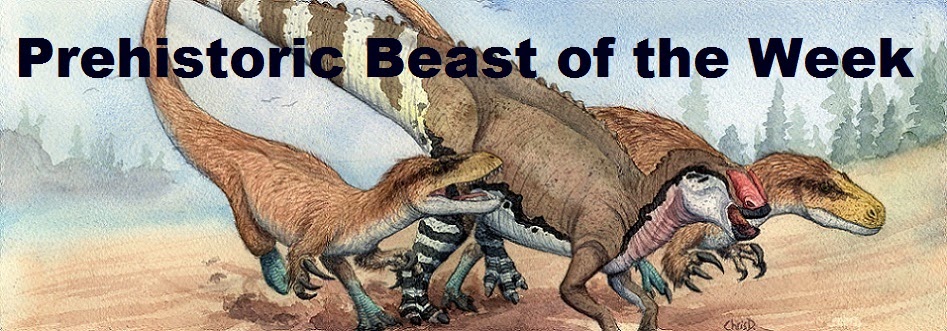
Yutyrannus life reconstruction by Christopher DiPiazza.

Yutyrannus belonged to the tyrannosauroid group, and was closely related to other dinosaurs like Guanlong, Eotyrannus, and Dryptosaurus.  Like them, it had characteristic curved, serrated teeth, and strong front arms, each tipped with three hooked claws.  It's later relatives would eventually develop the well-known two-fingered front limbs, best known in its slightly more distant relative, Tyrannosaurus.  Adult Yutyrannus also possessed a short horn in front of each eye and a ridge-like bony crest running down the top of its snout.  These features may have been used for combat or display within its species.  Yutyrannus had strong legs, but its foot bones were relatively short compared to those of some other theropods, suggesting it wasn't an extremely fast runner in life. It may have been better at ambushing, and then using its size and power to take down prey, rather than chasing it very far.

Yutyrannus cast mounted at the American Museum of Natural History in New York.

Yutyrannus' real claim to fame, however, is the fact that we know for certain it had feathers.  This is due to actual visual presence of fossilized feathers found on the remains of the three specimens that were found.  Because of the placement of these feathers, which includes the bottom of the pelvis, the tail, the arms, and the ankle, it is likely that Yutyrannus had a more even coat of plumage over most of its body in life.  This evidence makes Yutyrannus the largest dinosaur known to date with actual fossilized feathers.  (Other large dinosaurs, like Deinocheirus, show evidence of having had feathers by having a pygostyle, but not actual fossilized feathers found with its bones, which is what we have with Yutyrannus.)  These feathers weren't preserved well enough to tell exactly what kinds of feathers they were, but they most likely would have been somewhat shaggy in life, similar to those on modern ground birds, like emus or kiwis.


Shaggy kiwi.  If you're even in Washington D.C., check these guys out at the National Zoo.

So why feathers?  This is the first question that many people ask when learning about Yutyrannus.  A better question might be "why not feathers?"  Feathers are a versatile adaptation.  They can keep an animal warm when the environment is cold, but also cool when the environment is too hot.  They also serve as protection against the elements like precipitation or the sun, can help camouflage by obscuring the animal's basic body shape, and can aid with communicating to other members of the same species in a visual and/or behavioral way.  Thanks to finding Yutyrannus, we now think it is possible, and maybe even likely that tyrannosauroids all had feathers in some form, including T. rex.

Preserved feathers on the ankle (you can see the bones on the left) of Yutyrannus on display at the American Museum of Natural History in New York.

If you live in the New York / New Jersey area you can come see a  cast of the famous Yutyrannus fossil, as well as remains (casts and real fossils) of many other important feathered dinosaurs at the American Museum of Natural History's seasonal Dinosaurs Among Us exhibit, which closes in January, 2017.  Maybe I'll see you there!  That is all for this week.  As always feel free to leave a comment below or on the facebook page.

References

Xu, X.; Wang, K.; Zhang, K.; Ma, Q.; Xing, L.; Sullivan, C.; Hu, D.; Cheng, S.; Wang, S.; et al. (2012). "A gigantic feathered dinosaur from the Lower Cretaceous of China" Nature 484 (7392): 92–95.

Monday, March 28, 2016

Gigantoraptor: Beast of the Week

This week we will be taking a look at a dinosaur that gave paleontologists valuable information about fossil eggs, and the modern bird connections to prehistoric dinosaurs!  Enter Gigantoraptor erlianensis!

Gigantoraptor with nest life reconstruction by Christopher DiPiazza.

Gigantoraptor was an oviroraptorosaur theropod dinosaur that lived in what is now Mongolia, during the Late Cretaceous, about 70 million years ago.  It's name translates to "Giant Thief/Hunter" in reference to the fact that at a whopping twenty six feet long, it was much larger than other members of it's clade, like Oviraptor, Anzu, and CitipatiGigantoraptor is only known from one partial skeleton which was found to be still growing, so this dinosaur could have have been even larger as an adult.

Gigantoraptor skeletal mount on display in Japan.

Like its relatives, Gigantoraptor had a short, but deep and powerful beak, somewhat similar to a parrot's.  We know this thanks to a well-preserved lower jaw.  Sadly no upper skull has been found from Gigantoraptor yet.  What it used this beak to eat is still a total mystery.  It may have used it to crack open nuts or clip vegetation. Perhaps it was a meat-eater, as well, and used it to break bones?  Gigantoraptor also possessed three hooked claws on each hand and stood on two long, powerful legs.  For an animal its size, it was likely a fast runner.  Although there is no direct fossil evidence of it, Gigantoraptor almost certainly had feathers.

Eggs likely laid by Gigantoraptor with embryo skeleton.

Another really interesting thing about Gigantoraptor is the fact that paleontologists also have discovered its eggs! (and if they arent from Gigantoraptor they are from something EXTREMELY close to it.)  The eggs in question are almost cylindrical in shape, and each measure over twenty inches long!  Some of these eggs were carefully opened to reveal the bones of an oviraptorosaur embryo inside.  The eggs were discovered arranged in a ring formation.  This is typical for what we know about oviraptorosaur nest, thanks to relatives like Citipati, which were found actually brooding over the eggs laid in the exact position.  Gigantoraptor also would most likely have sat in the middle of this ring of eggs with its arms (which had feathers in life) spread over them for protection.  Within the ring of eggs, the eggs seem to have been laid in groups of two.  This is really important to know since it supports the idea that Gigantoraptor, along with many other egg-laying animals, possessed two oviducts in life.  Modern birds, and a few very bird-like nonavian dinosaurs are the only ones that have actually lost one of their oviducts as they evolved. (and do not pair their eggs as they lay them)  We used to think that birds developed this asymmetrical trait to become lighter and fly, but that doesn't explain why flightless dinosaurs like the troodontids evolved the same feature.

That is all for this week!  As always feel free to comment below or on our facebook page!

References

Wiemann J, Yang T, Sander PNN, Schneider M, Engeser M, Kath-Schorr S, Müller CE, Sander PM. (2015) The blue-green eggs of dinosaurs: How fossil metabolites provide insights into the evolution of bird reproduction. PeerJ PrePrints 3:e1323

Xu, X.; Tan, Q.; Wang, J.; Zhao, X.; Tan, L. (2007). "A gigantic bird-like dinosaur from the Late Cretaceous of China". Nature 447 (7146): 844–847.

Thursday, March 17, 2016

Interview with Paleontologist: Carl Mehling

Today we get to enjoy an interview with paleontologist, Carl Mehling!  Carl was one of the first people I became friends with since I started my involvement with the American Museum of Natural History.  He even led me on my first behind the scenes tour of the back fossil rooms.

Carl and I at the one of the museum's holiday parties.  He was wearing a Knights who Say Ni shirt...this HAS to be a great interview.

Carl Mehling has been at the American Museum of Natural History since 1990 and is currently a Senior Scientific Assistant taking care of the world’s largest collection of dinosaur fossils plus early synapsids and tetrapods, pterosaurs, crocodiles, turtles and marine reptiles. He is interested in all aspects of paleontology, especially the fringe areas that normally get little attention, including bizarre modes of fossil preservation, anomalous discoveries, and oddities within the history of paleontology. Carl collects fossils of all kinds, globally, and has written or edited a number of pieces on fossils, both scholarly and popular.


Question 1: Let’s start from the beginning.  What was your earliest sign of interest in paleontology that you can remember?

CM: I can remember, when I was maybe 5, my aunt and uncle gave my sister me each a Golden Book for Christmas. She got Dinosaurs and I got Three Little Indians. I remember successfully asking her to trade with me because I felt that dinosaurs were more appropriate for me. Who could argue?

Question 2: Did you have any professionals or family members who served as role models when you were younger?  Do you still have any now?

CM: My parents. My mom is very meticulous, detail-oriented, and experimental. And my dad was the quintessential armchair naturalist. Loved Nature and the outdoors. Loved exploring. And both Mom and Dad were very supportive of my interests. Lucky me!

Question 4: Was there anything you did or learned as you were on your way to your current career that you feel got you to where you are?  By this I mean any sort of field experience, a class, networking with the right people, or possibly something different or all three?

CM: Probably the most important things I wound up with were insatiable curiosity, a reasonably open mind, and flexibility/tolerance. Can’t exactly say whether I had these qualities innately or acquired and developed them but they have set before me a smooth and fascinating road. But having these in place certainly made field experiences, classes, networking, and all other aspects of my path more enjoyable and easier.


Question 5: Is the field of paleontology different now than from when you started as far as you can tell?  What would your advice be to anyone trying to make a career in paleontology (or science in general for that matter) now?

CM: Absolutely. I sense that it is more rigorous and more integrated and more populated. Or maybe I see it that way because I am growing with it and becoming ever more aware of how it all works. Who can say? But what has certainly changed is all the incredible technology we can throw at the fossils now: CT, synchrotron, lasers, UV, LiDAR, etc. We can see and detect things about which we previously couldn’t even form questions. Certainly the best time to be in paleo. But paleontologists have been saying this from day one. I suspect it is simply always true and true for Science in general. What advice would I give to the next wave? Keep that truth in mind.

Question 6: What was or is your favorite project in paleontology so far?  Would you be able to tell us about some of your current projects?

CM: My favorite project was maybe a bit of meta-paleontology. My first job at the AMNH was as part of the Installation Crew for the Fossil Halls renovation in the 1990s. Our crew was responsible for hanging most of the ceiling specimens in the Hall of Vertebrate Origins. We first crafted accurate cardboard models of what was to be hung. This was used to decide the exact placement and orientation of the exhibit object, which was then brought in, configured accordingly and raised to its display height. Cables were set and we were on to the next thing. Lots of creativity. Lots of varied skills put to work. Excellent people to work with.
As for what I am doing right now I am curating my huge collections of fossil plants and coprolites (fossil poop), plus a few other various things, into the AMNH collections. It’s a huge amount of work with many steps but so cathartic and gratifying.

Question 7: You have traveled to a lot of interesting places around the world for your research, including the deserts in Mongolia, to our backyard in New Jersey!  Do you have a favorite destination when it comes to fossils?  Why?

CM: I guess the Cretaceous of NJ will always be my favorite collecting. I have been digging there since 1988 and it consistently surprises me. And now I know the biota so well that they are all like old friends. But lately my mind has been happily lost in the Permian. I did some collecting this year in TX & OK and am blown away by the diversity and abundance. And so many of the animals we found were icons of the Permian that I knew very well since I was very young and meeting them on their turf was a definite thrill. If I lived closer to these beds I am certain they’d be my favorite. At least until I collected somewhere else…


Question 8: A popular image of paleontologists is that they are constantly out in the field digging up fossils, which is true to an extent.  What people don’t realize sometimes is that a lot of paleontology work is conducted in a lab as well.  In your experience, how much of your projects (in general) take place in the field, and how much are in the lab?

CM: The overwhelming majority is the non-field part. Field work focuses on speed and efficiency: get as much of what you seek in the small amount of time you have and get it “home” as safely as possible. After that you can take your time with the real work: cleaning, preparing, repairing, sorting, comparing, identifying, housing, documenting, labeling, cataloguing, accessioning, musing, etc. Sometimes there is even molding, casting, mounting, displaying, photographing, etc. Any of these steps can take a surprising amount of time but each is satisfying in its own way.

Question 9: I remember you telling me specifically that you have collected lots of small fossils, many times in favor of large “sexy” ones.  What is the reason for this? (other than the fact that they’re easier to carry.)

CM: Very hard to say precisely. Part of it is the absolute beauty of some of the tiny teeth and such you meet under the microscope. There is also a thrill in learning to recognize whole animals from surprisingly small pieces. I have a tiny chip of a tooth from the Cretaceous of NJ, maybe a millimeter or two across, whose enamel is the spitting image of that on a hadrosaur tooth from the same place. This miniscule mote came from an animal around 30 feet long. That kind of cognitive connection delights me. But yes, of course, I also love picking up a tiny, gorgeous fossil, which needs no prep, as opposed to digging something huge up for days or weeks. I am from the camp that enjoys prospecting more than quarrying. But I know plenty of folks who prefer the opposite. Something for everyone.


Question 10: Do you ever get criticized on any of your work?  How do you handle it?

CM: Since most of what I do is non-academic, and what I publish tends to be descriptive rather than postulative, I rarely get criticized for my work in paleo. But if one is in that position within any science, they must take it for what it usually is: the mechanics of Science. For Science to work it has to be a debate so that we can all get closer to the probable truth and not get seduced by our own suppositions.

Question 11: Jurassic Park and Land Before Time (opposite ends of the spectrum, I know) were just two of the programs I remember as a kid that helped fuel my obsession with paleontology.  Did you have favorite shows, movies, or even toys growing up that fueled your passion?

CM: Can’t really say if this influenced me or just fit into an already emplaced obsession, but the 70s Land of the Lost (I’m a bit embarrassed to say) was my go-to escape for a while.

Question 12: One of my pet peeves is when people assume paleontology doesn’t really do any real good in the grand scheme of things and is just a “for fun” science.  Do you think paleontology has a bigger part to than this?  How?

CM: Of course. Paleo is historical and thus as important as any history. Without the context of Life’s history we have no idea how we got here, how we fit in, and how life has dealt with all the slings and arrows of the Deep Past. We would have no idea what we are.


Question 13: Who was the first paleontologist you met?  How was that interaction?

CM: Since a paleontologist is anyone who studies fossils, I will assume you mean professional or academic paleontologist. Yet, I can’t exactly remember who was first. I got a behind-scenes-tour at the AMNH with Dr. John Maisey and Dr. Lowell Dingus in maybe 1989. I remember being dazzled and enthralled with everything I saw. They were very good gatekeepers to meet so early on and they are still good friends.

Question 14: Why do you think prehistoric animals are so influential to us today?

CM: I wrote a 60 page paper on this in college. It’s a surprisingly complex question. But basically fossils fuse fantasy with reality. The organisms they represent certainly existed. We want to know them. But the yawning gulf that separates us from fully knowing them allows is, urges us, to fill in the gaps with our imaginations. Humans are story tellers and fossils are the “One upon a time”s…

Question 15: What is your favorite prehistoric animal?  Was it different when you were younger?

CM: It was certainly different when I was younger because it changes ALL the time. Right now it is Petalodus, a Pennsylvanian shark known only from its especially bizarre teeth. Petalodus is my current favorite because I collected my first Petalodus teeth a couple of months ago. My favorite with certainly change in a flash. I am not loyal to any one organism.

Question 16: If you could use a time machine to go back and pick only one prehistoric animal to bring back from history and observe alive and in person, which would it be and why?

CM: Again, it would be Petalodus because it’s in my head and so secretive. But some recent head scratchers that excited me are Atopodentatus, Deinocheirus, Dimetrodon, the new giant Romanian pterosaur, the new giant Argentine titanosaur, Yi qi, any carpoids or eurypterids, Didymoceras. Why? Because they are mysterious!

Dimetrodon

Question 17: Back to the time machine.  This time you can go back to any place and time period and have a look at what the environment was really like.  Which one would you pick and why?

CM: Right now it would be the Permian since that’s where my head is at the moment. But in general, it would be “older is better.” The less it would look like the familiar biota of today the more excited by it I would be.

Question 18: Which is your favorite museum?  Why?

CM: I do, of course, love the AMNH. It’s huge, has an incredible collection whether you look at its diversity, scope, or sheer numbers. I know the history very well and love the stories and characters. But I also love well done, small, regional museums. One that comes to mind is the tiny but complete Santa Cruz Museum of Natural History.

Question 19: What hobbies do you have?  (Don’t have to be paleo-related.) 

CM: Inside and outside of my job I focus on fossils. But since we’ve heard all about that… I am also a letterer with a special focus on ambigrams. I love linguistics and its evolutionary aspects. I love the outdoors, above and below water. I adore food in all of its incredible variety.


Sunday, March 13, 2016

Acheroraptor: Beast of the Week

This week let's take a look at a mysterious, yet at the same time, very familiar dinosaur.  Check out Acheroraptor temertyorum!

Acheroraptor was a meat-eating dinosaur that lived during the Late Cretaceus Period, about 66 million years ago in what is now the Montana, USA.  It is estimated to have measured about six feet long from snout to tail, but this is mostly based on the proportions of other related dinosaurs that are more completely known, since Acheroraptor is known from very fragmentary remains.  The genus name translates to "Underworld Thief" in reference to the Hell Creek Formation, the geological formation in Montana, from which its remains, along with those of many other dinosaurs, were unearthed.  When alive, Acheroraptor lived alongside very famous creatures, like Tyrannosaurus, Triceratops, and Ankylosaurus, as well as Quetzalcoatlus, Pachycephalosaurus, Anatotitan, and Anzu.

Acheroraptor life reconstruction by Christopher DiPiazza. (Mostly based off Velociraptor)

Acheroraptor was a member of the dromaeosaurid family.  These predatory dinosaurs were known for being relatively small, feathered, and for having a retractable sickle-shaped claw on each foot.  The most famous member of this group, obviously being Velociraptor.  This family of dinosaurs can be tracked back to the early Cretaceous where they proceeded all the way to the very end of the Mesozoic Era, Acheroraptor, being one of the very last, and was likely one of the species to have died out when the meteorite hit the earth, 66 million years ago.

Acheroraptor has been known about for a long time, in the form of isolated teeth scattered around the Hell Creek formation, but was never given a formal name.  Believe it or not, paleontologists who know their dinosaurs can identify a tooth alone as being from a dromaeosaur!  Dromaeosaur teeth tend to be triangular, blade-like, and have serrations on both sides.  It was simply referred to as "That dromaeosaur from the Hell Creek Formation" for years until some fragments of its actual jaws were finally found and it was formally named and described in 2013.

Known Acheroraptor jaw material from Evans' 2013 paper.

What's interesting about Acheroraptor is that, despite the fact that it lived in North America, by closely examining its teeth and the shape of its jaw, paleontologists were able to deduct that it was most closely related to Asian droameosaurids, like Velociraptor, and not other North American dromaeosaurids like Dromaeosaurus or Deinonychus.  This suggests that Acheroraptor's ancestors migrated to North America from Asia when the continents were connected.  This is also thought to have been the case with its contemporary, Tyrannosaurus, which also had earlier, close relatives from Asia.

That is all for this week!  As always feel free to comment below or on our facebook page!

References

Evans, D. C.; Larson, D. W.; Currie, P. J. (2013). "A new dromaeosaurid (Dinosauria: Theropoda) with Asian affinities from the latest Cretaceous of North America". Naturwissenschaften.

Wednesday, March 2, 2016

Aerodactylus: Beast of the Week

This week we will look at a newly discovered (sort of) pterosaur with a really cool name.  Enter Aerodactylus scolopaciceps!

Aerodactylus was a pterosaur that lived in what is now Germany, during the Late Jurassic Period, around 150 million years ago.  It is only known from juvenile specimens with small, roughly one-and-a-half foot wingspans.  Adults would probably have been a bit larger than this, perhaps possessing about three-foot wingspans.  (This is purely based on estimates of adults of similar, more completely-known pterosaurs, like Pterodactylus.  Adult Aerodactylus may have been different.)  Aerodactylus was most likely a meat-eater when alive, using its jaws to snap up small prey.  The genus name, Aerodactylus translates to "Air Finger" but there's more to it than that.  It was really named after Aerodactyl, which is a pokemon...based on a pterosaur.  So to sum that up for you pterosaurs inspired the creation of the fictional character, Aerodactyl, which in turn, inspired the name of the actual genus of pterosaur, Aerodactylus.  I love it!

Life reconstruction of Aerodactylus by Christopher DiPiazza.
Aerodactylus was discovered and described back in the 1850s but it was considered a species of Pterodactylus at the time.  The two were similar in appearance and both lived in what is now Germany during the same time period so it was easy to assume that they were more closely related than they really were at the time.  In 2014 the specimens we now call Aerodactylus, were examined more closely, and were discovered to be different enough to warrant their own genus.  They had a different number of teeth, which were were more sparsely arranged in the mouth, differently shaped skulls and eye sockets, longer tail vertebrae, and slightly differently proportioned wings.  These characteristics seem minimal at first, but they are important.  In fact, Aerodactylus was determined to not even belong to the same family, let alone genus, of pterosaur as Pterodactylus

Aerodactylus, thanks to a few very well-preserved specimens, tells us that it would have had a crest on its skull in life, webbed toes, and a pouch under its throat.  All of these characteristics, combined with the fact that it fossilized in what was a lagoon of some sort at the time of its death, support the idea that Aerodactylus was adapted for living and hunting near the water.  Its long jaws, with pointed teeth concentrated towards the tips could have been for snapping up small fish or invertebrates in shallow water, and its webbed toes could have aided it if it waded or swam on the surface of deeper water. 

Aerodactylus juvenile specimen from Vidovic's 2014 paper.  This famous fossil was referred to as Pterodactylus kochi for a long time.  Note the well-preserved throat pouch and outline of the uropatagium (webbing between inner leg and thigh), neck and shoulders,

That is all for this week!  As always feel free to comment below or on our facebook page!

References

Vidovic, S. U.; Martill, D. M. (2014). "Pterodactylus scolopaciceps Meyer, 1860 (Pterosauria, Pterodactyloidea) from the Upper Jurassic of Bavaria, Germany: The Problem of Cryptic Pterosaur Taxa in Early Ontogeny". PLoS ONE 9 (10): e110646.

Sunday, February 28, 2016

The Paleontology Behind Pokemon

Pokemon, the franchise about collecting creatures to raise and battle against one another, is a video game franchise that stands out as one of the most unique and successful...ever.  Yes, I am aware that the premise is similar to dogfighting, but the difference here is that...pokemon isn't real and nobody gets hurt!  I was in fourth grade when it hit the United States and was amongst the first wave of kids to become captivated by it.  Twenty years later (this week!) I still find pokemon to be a great game.  (and not just for kids necessarily, either!)  So what is an article about pokemon doing on a website about paleontology?  Well since it was a franchise about made up creatures with superpowers, how could some of them not have been based on prehistoric animals?  In fact, in order to get certain pokemon based on dinosaurs and other prehistoric life, the player needed to collect fossils in the game and bring them to life!  Don't you wish we could just do that with real fossils?  No more debates about feathers.  Then again, it sort of takes some of the wonder out of it...

Anyway, I decided to make a list of some pokemon that are based on prehistoric animals and explain to you a little bit about the real creatures they were based on.  There are more pokemon than this list that are based on prehistoric beasts, but these are my favorites.  Hope you enjoy!

Venusaur


Venusaur and its younger phases are a little tough to pin down at first.  It has the term "saur" in its name, so the dinosaur bell rings in most people's heads upon hearing about it.  Physically, however, it looks more like a big frog than anything else.  However, looking at this guy's slightly beak-like mouth, protruding teeth, and the presence of small, mammal-like ears, it could very well be based on a different kind of prehistoric creature, a kind of dicynodont.

Lystrosaurus, a kind of dicynodont, at the Museum of Paleontology, Tuebingen. (Photo by Ghedoghedo wikimedia commons)

Dicynodonts of many different kinds lived during the late Permian into the Triassic period.  They were not true dinosaurs, but synapsids, more closely related to more well-known creatures like Dimetrodon...and mammals.  They would have waddled around on four squat legs, and had beaks with tusks they may have used to dig up plant material or invertebrates to eat.  It is unknown exactly what their skin covering was like in life, whether or not they were scaly or fuzzy, or perhaps both.

Aerodactyl


This might be my all time favorite pokemon, since I have been using it ever since I played the pokemon gameboy game back in the late 90s.  Aerodactyl is prehistoric, even in the game, since it needs to be revived from a fossil in order to be obtained.


Yes, that's my Aerodactyl.  I have cool hobbies.  And for all you really hard-core poketrainers out there, yes, it is IV and EV trained as well.  Leave a comment if you want to exchange friend codes or lose to me in a battle.

Judging by the name and its looks it is clearly a stylized pterosaur...or TERRORDACTILE, as I like to call them.  I have seen other people try to pinpoint exactly which genus of pterosaur Aerodactyl is based on, but I think there is a point where you need to just be okay with the idea that whomever designed this creature, was using their own imagination, too.  It ends up looking more like dragon(also technically based on dinosaurs) than anything else.

Omastar and Kabutops


These guys, along with Aerodactyl, and a few others on this list, also needed to be revived from fossils in the game.  They were also in the first generation of pokemon to be introduced to the world.  Because of this, I was particularly impressed that two of the three kinds of fossil pokemon in the game were actually based on invertebrate fossils (vastly underappreciated even by the paleo community sometimes!) in the forms of an ammonite and trilobite.

Cheirurus, a genus of trilobite that resembles Kabutops. (Photo by By Vassil - wikimedia Collections.)

Ammonites and Trilobites are sort of the poster children for fossils that aren't dinosaurs.  They are relatively common around the world and have easily recognizable shapes.  Ammonites were extinct cephalopods (mollusks with big heads and tentacles like modern octopi and squid) and trilobites were extinct arthropods most closely related to today's horseshoe crabs.  In fact, Kabutops' first "evolution" (young form...pokemon sort of dropped the ball on their definition of evolution.  They should have called it metamorphosis.) looks most like a horseshoe crab.

Anorith


Like the above two pokemon, this guy also is based on an underappreciated invertebrate fossil. Anorith is based on an Anomalocaris, an interesting kind of, now extinct, invertebrate not really like anything alive today.  They are thought to be most similar to modern arthropods, though.  The odd, five-eyed, Opabinia, is in the same order.

Anomalocaris fossil at the Royal Ontario Museum (Photo by Keith Schengili-Roberts wikimedia commons)
This pokemon "evolves" into  bigger form, which looks more stylized and less like an actual prehistoric animal.
Sceptile


Sceptile's first form, is clearly based on a modern gecko.  But its fully mature form shares a lot of characteristics with theropod dinosaurs.

Dilophosaurus skull on display at the American Museum of Natural History.

It is tough to say exactly which kind of theropod was inspiration for this pokemon.  It could be argued that its based on a maniraptor because of the feather-like leafy appendages growing from its arms.  I have also heard some compare it to a Dilophosaurus because of the two crests on its head.  It most likely is a generally, stylized, cool dinosaur look though.

Torterra


Torterra, like Sceptile, can possibly argued to have been based on a tortoise, since its younger forms are definitely based on testudines.  I think it was at least partially designed after ankylosaurids, however.


Ankylosaurus skull.

Yes, even the name has "Tort" in it, but look at it!  It has to be those horns on the sides of the head.  It really gives it an Ankylosaurus look, even if it doesn't have a bony mass on the tail.

Archeops


Archeops was definitely based on feathered maniraptoran dinosaurs.  In fact, in the game it is even said to have been an ancestor of modern "bird pokemon".  (So pokemon does actually understand the real meaning of evolution!  Good to know.)

Microraptor fossil showing the feathers on the legs and tip of the tail. 

At first when I saw Archeops I thought it was based on an Archaeopteryx, which is the poster child for the bird/nonavian dinosaur connection.  But it could have been drawn more from dinosaurs like Microraptor, since it has a skinny tail with a small fan of feathers at the tip, and long feathers on its legs.  Despite being very stylized, this pokemon is an obvious nod to relatively recent fossil discoveries in the field of paleontology, which I found really cool.

Rampardos and Bastiodon


I love marginocephalians dinosaurs!  So imagine how thrilled I was back in 2006 when I saw that pokemon finally released two fossil pokemon that were based on a pachycephalosaur and ceratopsian respectively.

Stygimoloch skull on display at the Museum fur Naturkunde in Berlin.

Rampardos and its first form seem to be pretty nonspecific pachycephalosaurs.  I have seen some try to argue that Rampardos is specifically a Stygimoloch because of its horn proportions but honestly, it's a stylized cartoon, so I wouldn't really try to pigeonhole it that much.  Bastiodon, despite that ugly face, was based on some sort of long-frilled ceratopsian, like Triceratops or Chasmosaurus.  I like how they made the epoccipitals look like the top of a castle.


Aurorus


Aurorus was based on an Amargasaurus.  It is pretty cool how they made the sail of the Amargasaurus, into an aurora borealis.  In the game, this sail can rapidly flap like a flag.

Amargasaurus skeleton on display at the Melbourne Museum.

In real life, the sail of Amargasaurus was connected by spines attached to the neck vertebrae.  There have been  few other pokemon based on sauropods, but nothing as specific as this, and a cool genus of sauropod, too!

Tyrantrum

 
It can be argued that there have been a few pokemon based on Tyrannosaurus, before, but they look to be more based on kaijus than than real dinosaurs.  That is until Tyrantrum. 

Not only does this pokemon stand horizontally with its tail balanced behind it like a real large theropod would have, but it also appears to have feathers.  At least that's what I like to hope the white ruffly stuff around its neck and chin is.  I could be wrong.  But if I'm right, pokemon is more with the times than some science-based dinosaur reconstructions!

Hope you enjoyed the list!  Happy 20th, Pokemon!
Monday, February 15, 2016

Mojoceratops: Prehistoric Beast of the Week

Today we will be checking out a ceratopsian dinosaur that may have used its frill to attract potential mates.  Check out Mojoceratops perifania!

Mojoceratops was a plant-eater that lived in what is now Canada, during the late Cretaceous, between 76.5 and 75 million years ago.  From beak to tail, Mojoceratops was about fifteen feet long.  Its genus name translates to "Mojo horned face" and the species name, perifania, is Greek for "pride".  In the early 1900s, mojos, were trinkets that were said to grant their owners with being more sexually attractive to others. Both parts of the name reference this dinosaur's large frill, which may have been a display adaptation in life, possibly for attracting mates.

Mojoceratops life reconstruction by Christopher DiPiazza.  These dinosaurs, like the rest of their kin, probably used their frills as display adaptations to impress or intimidate each other.

Mojoceratops was one of those dinosaurs that has gone through a few identity mix-ups since its discovery.  Originally, it was classified as a species of Chasmosaurus, another ceratopsian dinosaur that was very similar to it.  Then, some time later, it was re-evaluated and given it's own genus, Mojoceratops, due to the fact that its frill and horns aren't exactly the same as those of Chasmosaurus specimens.  Now, as of 2016, Mojoceratops has been re-re-evaluated...and is once-again considered just another kind of Chasmosaurus since we now understand that ceratopsian frills and horns had a pretty wide range of variability among individuals, even within the same species due to age or sex, possibly.  Regardless of what you call it, Mojoceratops/Chasmosaurus was what it was. (Pet peeve of mine when people say "It never existed!" when a name isn't valid.  The fossil is right there!)

Partial skull, including the frill, from Mojoceratops.  Note the heart shape on the top.  This specimen has since been assigned to Chasmosaurus russelli.

In addition to the tall frill, which had a dip in the middle, making it almost heart-shaped, Mojoceratops also possessed three horns on its face.  The two over each eye were relatively long, thin, and angled upwards and slightly to the sides.  The nose horn was actually pretty flat laterally, and almost rectangular.  Like the frill, these horns were likely display adaptations.  They may have also helped Mojoceratops defend itself from predators if it had to.


Mojoceratops skull on display at the American Museum of Natural History in New York.  When it was first erected it was labelled as a species of Chasmosaurus and the label was never changed.  Now it's been re-reassigned to Chasmosaurus again so extra work averted!  The back part of this specimen's frill was never found and was reconstructed to match other known Chasmosaurus material.

Like all ceratopsians, Mojoceratops had a curved beak that was ideal for clipping vegetation which would then be shredded up by batteries of small teeth in the back of the mouth.  There are some who hypothesize that ceratopsians were omnivores, using their beaks and teeth to eat meat as well, but there is no evidence that suggests this on the fossil record thus far.  Since occasional meat consumption can be seen in modern animals that are typically herbivorous it probably isn't out of the realm of possibility, but it is completely unknown if ceratopsians were exhibiting this feeding hebavior regularly.

That is all for this week!  As always feel free to comment below or on our facebook page!

References

Campbell, J.A., Ryan, M.J., Holmes, R.B., and Schröder-Adams, C.J. (2016). A Re-Evaluation of the chasmosaurine ceratopsid genus Chasmosaurus (Dinosauria: Ornithischia) from the Upper Cretaceous (Campanian) Dinosaur Park Formation of Western Canada

Nicholas R. Longrich (2010). "Mojoceratops perifania, A New Chasmosaurine Ceratopsid from the Late Campanian of Western Canada". Journal of Paleontology 84 (4): 681–694.