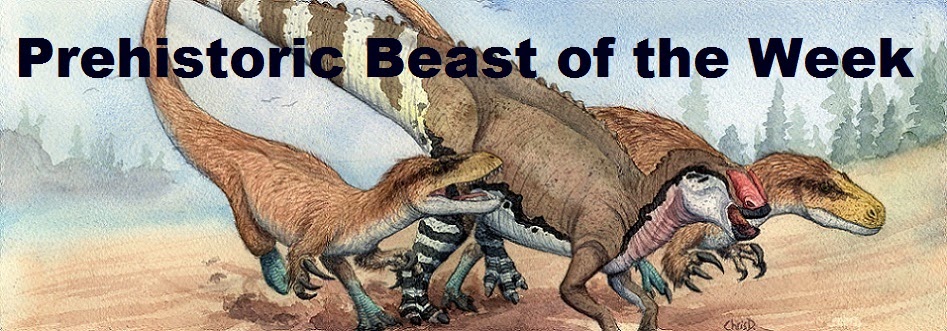
Torvosaurus lived about 150 million years ago during the Late Jurassic period. Its bones have been unearthed in Colorado, USA, Portugal, and possibly Germany (Europe and North America were not as vastly separated back then, remember, so a lot of the dinosaurs on each of them from that time shared recent ancestors). From nose to tail it measured up to 36 feet (about 11m) and would have been among the largest, most formidable meat eaters of its time. The name, Torvosaurus, translates to "Fierce Reptile".
.jpg) |
| Torvosaurus in watercolors life reconstruction by Christopher DiPiazza. |
Torvosaurus is a member of the megalosaurid family, and is closely related to the more famous, Megalosaurus. Megalosaurids are mostly known from the middle and late Jurassic period, and are not super well known, since not many of them have ever been found compared to most other dinosaurs. That being said they tend to have long, low skulls with large robust teeth with serrations for cutting meat. Their arms were powerful with three fingers, tipped with proportionally large hooked claws. Their legs also tend to be proportionally shorter. The more popular spinosaurs are currently thought to be closely related to the megalosaurids (both are classified within the broader megalosauroid group), and it is likely that the megalosaurids gave rise to the first spinosaurs, although we currently don't have any obvious transition fossils that demonstrate this yet.
Torvosaurus, itself, currently contains two distinct species. Torvosaurus tanneri from North America, and the slightly larger Torvosaurus gurneyi, from Europe.
Torvosaurus is especially important to paleontology because its one of the few dinosaurs paleontologists have actually found eggs from. The nest of eggs found in Portugal, appeared to have been methodically buried in life by the parent. They were close to hatching because the bones of embryos were also found inside, making them the oldest theropod dinosaur embryos known to science.
 |
| Torvosaurus tanneri Skeletal mount on display at the Mesalands Dinosaur Museum in New Mexico. |
Torvosaurus is especially important to paleontology because its one of the few dinosaurs paleontologists have actually found eggs from. The nest of eggs found in Portugal, appeared to have been methodically buried in life by the parent. They were close to hatching because the bones of embryos were also found inside, making them the oldest theropod dinosaur embryos known to science.
When alive Torvosaurus tanneri would have coexisted with many famous dinosaurs, including the long-necked sauropods, Apatosaurus, Brontosaurus, Diplodocus, Barosaurus, Camarasaurus, and Braciosaurus, the armored Stegosaurus and Gargoyleosaurus, and the ornithopod Camptosaurus, all of which it may have hunted. It also would have coexisted with fellow predators, Allosaurus and Ceratosaurus. In Europe Torvosaurus gurneyi lived alongside Allosaurus (European species) and the long-necked stegosaur, Dacentrurus, to name just a few.
References
Araújo, Ricardo; Castanhinha, Rui; Martins, Rui M. S.; Mateus, Octávio; Hendrickx, Christophe; Beckmann, F.; Schell, N.; Alves, L. C. (2013). "Filling the gaps of dinosaur eggshell phylogeny: Late Jurassic Theropod clutch with embryos from Portugal". Scientific Reports. 1924 1924: 8.
References
Araújo, Ricardo; Castanhinha, Rui; Martins, Rui M. S.; Mateus, Octávio; Hendrickx, Christophe; Beckmann, F.; Schell, N.; Alves, L. C. (2013). "Filling the gaps of dinosaur eggshell phylogeny: Late Jurassic Theropod clutch with embryos from Portugal". Scientific Reports. 1924 1924: 8.
Chure, Daniel J.; Litwin, Ron; Hasiotis, Stephen T.; Evanoff, Emmett; and Carpenter, Kenneth (2006). "The fauna and flora of the Morrison Formation: 2006". In Foster, John R.; and Lucas, Spencer G. (eds.). Paleontology and Geology of the Upper Jurassic Morrison Formation. New Mexico Museum of Natural History and Science Bulletin, 36. Albuquerque, New Mexico: New Mexico Museum of Natural History and Science. pp. 233–248.
Mateus, O., Walen, A., and Antunes, M.T. (2006). "The large theropod fauna of the Lourinha Formation (Portugal) and its similarity to that of the Morrison Formation, with a description of a new species of Allosaurus." New Mexico Museum of Natural History and Science Bulletin, 36.
Mateus, O., & Antunes, M. T. (2000). Torvosaurus sp.(Dinosauria: Theropoda) in the late Jurassic of Portugal. In I Congresso Ibérico de Paleontologia/XVI Jornadas de la Sociedad Española de Paleontología (pp. 115-117).
Mateus, O., Walen, A., and Antunes, M.T. (2006). "The large theropod fauna of the Lourinha Formation (Portugal) and its similarity to that of the Morrison Formation, with a description of a new species of Allosaurus." New Mexico Museum of Natural History and Science Bulletin, 36.
Mateus, O., & Antunes, M. T. (2000). Torvosaurus sp.(Dinosauria: Theropoda) in the late Jurassic of Portugal. In I Congresso Ibérico de Paleontologia/XVI Jornadas de la Sociedad Española de Paleontología (pp. 115-117).
Ribeiro, Vasco; Mateus, Octávio; Holwerda, Femke; Araújo, Ricardo; Castanhinha, Rui (March 4, 2014). "Two new theropod egg sites from the Late Jurassic Lourinhã Formation, Portugal". Historical Biology. 26 (2): 206–217.

No comments:
Post a Comment