Sunday, September 20, 2020

Camptosaurus: Beast of the Week

Camptosaurus dispar was a plant-eating dinosaur that lived in what is now South Dakota, USA, during the late Jurassic Period, roughly 150 million years ago.  Adults measured about 25 feet long from beak to tail, although there is observed variation among individuals.  The genus name, Camptosaurus, translates from Greek to "Bent Lizard/Reptile" in reference to the fact that paleontologists at the time of its discovery predicted its vertebra would have allowed for greater flexibility than what they had observed in other dinosaurs thus far. Camptosaurus was an ornithopod dinosaur, who's lineage would later give rise to the more widespread iguanodontids, and the even more derived hadrosaurids.

Camptosaurus dispar hunkers down during a rainstorm in what is now western North America during the late Jurassic.  Watercolor reconstruction by Christopher DiPiazza.

Camptosaurus was a heavily-built dinosaur, possessing powerful legs, which were longer than its arms.  Its arms, although shorter, would have been powerful and flexible and its fingers, of which it had five of on each hand, would have been somewhat dexterous and able to grasp things, like branches while feeding.  This is in contrast to later forms of ornithopod dinosaurs, like the hadrosauroids, who's fingers were fused together, an adaptation for weight bearing.  Since Camptosaurus lacks this feature, paired with the fact that its front limbs were proportionally shorter, it is likely that this dinosaur was more comfortable as a biped than a quadruped, although it was also capable of four-limbed locomotion if need be.  

Camptosaurus skeletal mount on display at the American Museum of Natural History in New York.  This specimen might represent a juvenile.

Camptosaurus possessed a proportionally small skull on the end of a long, flexible neck.  Its snout was narrow and ended in a slightly downturned beak.  Inside the jaws, Camptosaurus and many small, tightly packed teeth which were ideal for processing plants.  The amount of wear that paleontologists observe on Camptosaurus teeth suggests it was capable of eating tougher plants than many other plant-eating dinosaurs it shared its environment with.  Camptosaurus also had large eye sockets with small ridges over them, which would have given it a superficial "angry expression" on its face in life.  This is possible an adaptation for protecting its eyes from sun glare.  You can observe similar adaptations in some bird species alive today.  Because of this it is possible that Camptosaurus had relatively good vision, and could have been most active during the daytime.  

Mount of an Adult Camptosaurus on display at the National Museum of Natural History in Washington D.C.  

When alive, Camptosaurus would have coexisted with many large sauropod dinosaurs as well as some of the armored stegosaurs in life.  Its ability to easily transition between bipedal and quadrupedal postures while feeding may have helped it carve out a niche in a world that was already so dense with herbivores.  At the same time it could have relied on its sharp vision and longer hind legs for running to avoid predators, like Allosaurus, Ceratosaurus, and Torvosaurus.  

References

Carpenter, K.; Wilson, Y. (2008). "A new species of Camptosaurus (Ornithopoda: Dinosauria) from the Morrison Formation (Upper Jurassic) of Dinosaur National Moument, Utah, and a biomechanical analysis of its forelimb". Annals of the Carnegie Museum76 (4): 227–263.

Gilmore, C.W. (1909). "Osteology of the Jurassic reptile Camptosaurus, with a revision of the species of the genus, and descriptions of two new species". Proceedings of the United States National Museum36 (1666): 197–332.

Foster, J. (2007). "Camptosaurus dispar." Jurassic West: The Dinosaurs of the Morrison Formation and Their World. Indiana University Press. p. 219-221.

Marsh, O.C. (1879). "Notice of new Jurassic reptiles". American Journal of Science and Arts18 (108): 501–505.

Saturday, September 19, 2020

Show Review: Jurassic World Camp Cretaceous

 Despite its inaccuracies, I will always be a sucker for the Jurassic Park franchise.  It wasn't what originally got me into dinosaurs as a kid, but seeing dinosaurs in the mainstream certainly had a positive effect on me back when the first movie hit theaters.  That being said, I thought it was a great move for Netflix to make a TV series based on Jurassic World, Camp Cretaceous.  It's a good way to keep fans engrossed in the franchise between movies.  (It worked with Star Wars!) I sat down and binged all eight episodes so I could share my thoughts for you here.  This means if you don't want spoilers you should stop reading.  Again, SPOILERS AHEAD.  STOP READING IF YOU HAVEN'T FINISHED THE SHOW!!!

It's not obvious at first, but setting wise Camp Cretaceous takes place during the exact same time and place as the Jurassic World Movie from 2015.  The only character who actually appears and has a speaking role in both the show and the movie is Dr. Wu.  However, many other characters from the movie are name-dropped in the show, including Claire, Masrani, Zak, Gray, and even Alan Grant and John Hammond from the original movies.  The fact that this adventure is unfolding parallel to the events in the movie we saw back in 2015 is interesting to me.  There are moments when events in this show miss events in the movie by mere seconds, like when the campers watch from a distance as Masrani's helicopter crashes into the pterosaur dome, or when they stumble upon the aftermath of the Indominus rex's fight with the Ankylosaurus.  To think that during that gruesome battle, there was a tiny adorable baby Ankylosaurus with lopsided horns just a few feet away in the bushes waiting to pop out.  By the way this brings us to...

She is better than Baby Yoda.  There.  I said it.

Bumpy.  Bumpy is a baby Ankylosaurus that hatches in the lab like all the other Jurassic World dinosaurs. Unlike all the other dinosaurs, however, Bumpy has a genetic mutation causing her horns to be different sizes.  This isn't the first time a baby Ankylosaurus has been a character on TV.  The short-lived show, Terra Nova, which originally aired on FOX, as well as the Japanese animated film, You are Umasau, both featured lovable baby Ankylosaurus in prominent roles.  That being said, I think Bumpy is the most adorable.  She's even better than Baby Yoda.  There.  I said it.  

One thing that stood out to me about this show after I had finished the season was that the creators made the choice to leave out the two dinosaurs you'd expect to be the most prominent in a Jurassic World show.  Velociraptor, which is a main presence in every movie so far, is only in one episode for one scene towards the beginning of this show.  Tyrannosaurus doesn't appear in the actual story at all and only appears in the introduction credits. (a bit of false advertising)  Story wise this makes sense, however, given these dinosaurs' roles in the movie's plot that's occurring at the same time, but I was still surprised given how popular they both are and that they weren't worked in more.  

Another popular dinosaur that's left out that makes less sense is Triceratops.  The three-horned beast doesn't appear at all.  It's relative, Sinoceratops, however, has a big role.  This is weird since in the movie's story Triceratops was all over the place, especially in the field where the gyrospheres go, and Sinoceratops was completely absent, not appearing at all until the latest movie, Jurassic World Fallen Kingdom, which takes place years later.  I can't imagine a reason why they decided to switch the two ceratopsians other than maybe since the latest movie was fresh in everyone's minds and therefore they thought Sinoceratops would be received better? Sinoceratops was mostly included in the movie to appeal to Chinese audiences (replacing what would have been Pachyrhinosaurus relatively late in production) but Netflix isn't a streaming service in China, so I don't think this was the reason when it came to the show.  Regardless I'm happy a lesser-known dinosaur is getting some more mainstream attention. (even if it has inaccurate holes in its frill...)

A dinosaur also that have a prominent roll in this show as a main antagonist is Carnotaurus.  Carnotaurus has been an increasingly popular dinosaur even before it was featured in the last movie, so putting it in this show was a cool choice.  I also appreciate how it has a moment when it actually acts like a normal animal and not a mindless killing machine. (If you've watched the show you know what I'm referring to.) I love how the show pokes fun at the Carnosaurus having smaller arms than T. rex, with one character teasing the predator saying "your arms are practically vestigial."

Speaking of realistic animals, the show does...try... to throw some references to actual nature in there.  Here's some examples I noticed... 

Many animals alive today can absorb ultraviolet light and emit it into colors that we humans can only see under special UV lights.  Many of these same animals, including birds and some other reptiles, can see these colors under normal conditions, and use these "hidden colors" to communicate with one another.  This means that the colors you see on the feathers of a bird is a very different image that the birds are seeing when they look at each other.  The Parasaurolophus in the Camp Cretaceous are depicted displaying their own form of photoluminescence, by glowing unearthly blue when in a cave.  Is there direct evidence of this sort of thing in the fossil record?  No.  But it's a fun concept and could be possible given how dinosaurs are nestled in the tree of life among other animals we do know exhibit it.  In fact, A recent scientific paper by Darren Naish, Cary Woodruff, and Jamie Dunning, even investigates this vey idea.  It's certainly not the weirdest thing a Jurassic Park dinosaur has done.  *looks at spitting, frilled Dilophosaurus*

The top photo of a puffin exhibiting photoluminescence (by Jamie Dunning) isn't impossible for prehistoric dinosaurs.  Interestingly enough, the Parasaurolophus from Camp Cretaceous, are depicted glowing, possibly because of genetic tampering.

One of the characters on the show has a background in cattle farming.  During a scene where a Sinoceratops gets spooked and runs away from the herd, this character explains the proper way to herd a scared animal back to the herd without causing the rest of the herd to panic, using her first-hand knowledge of livestock behavior.  Ceratopsians are often compared to modern bovids a little too much simply based on the fact that they have horns and eat plants, but the fact that they tried to apply real animal behavior to their fictional dinosaurs was refreshing in a franchise where the dinosaurs often act too much like humans or slasher villains.  A similar situation occurs when the Pteranodons attack the kids on a monorail at night, where one character states that the pterosaurs are attracted to the lights inside the train, like birds would be.  This is actually true.  Birds are attracted to and then often confused by light at nighttime.  In fact, a major cause of death for migrating birds is crashing into people's windows when their lights are on at night.  

Lastly there are plenty of references to all the Jurassic Park/World movies sprinkled throughout this show.  Dinosaurs that don't have actual roles, like Spinosaurus, are still depicted in passing imagery in books, posters, computer monitors almost constantly during the show.  Another more specific reference I particularly liked was how the kids discover a cattle prod at the same time they encounter a pack of Compsognathus, which is a nod to the second installment of the Jurassic Park Franchise, The Lost World from 1998, where a character uses one to needlessly torment the tiny dinosaurs, only to be ripped apart by them later.  Lastly, not a Jurassic Park reference, and maybe I'm just seeing what I want to see here, but during the scene where the Carnotaurus trips and proceeds to push itself up a narrow staircase in pursuit of the kids on its belly, I instantly thought of the scene from The Land Before Time where the Tyrannosaurus, "Sharptooth" pushes himself through a thorn patch in much the same way as he tries to attack the baby dinosaurs.  

This scene reminded my of The Land Before Time, the way the dinosaur is sliding along on its belly as it attempts to chomp the heroes.

Overall I was pleasantly surprised with this show and I really hope they come through with a second season.  It's a little darker than what the seemingly kid-friendly animation style might lead you to believe.  People die in the show, but no blood or gore is actually shown.  (it's rated PG, not PG-13 after all!) The human characters, themselves, also have some decent dialogue and character development.  The camp counselors are terrible though.  They should totally get fired from their jobs for leaving those kids by themselves unattended so many times.  I also appreciate the diversity in the cast of characters, which includes lots of women and people of color, who are grossly underrepresented when it comes to dinosaur media.  

What did you think of the show?  What are some references that you noticed? Share in the comments below!

References

Woodruff, D. C., Naish, D. & Dunning, J. 2020. Photoluminescent visual displays: an additional function of integumentary structures in extinct archosaurs? Historical Biology 

Sunday, August 30, 2020

Pectinodon: Beast of the Week

Today we will be checking out a the bird-like dinosaur, Pectinodon bakkeri!  Pectinodon lived in what is now Wyoming, USA, during the latest Cretaceous period, about 66 million years ago.  Pectinodon is only known from highly fragmentary remains (mostly teeth) but is roughly estimated to have measured about six feet long from snout to tail when alive.  It would have eaten meat and possibly some plant material when it was alive.  Its genus name translates to "Comb Tooth" because of the deep serrations on the anterior edges of its teeth.  The species name is in honor of paleontologist, Dr. Robert Bakker.

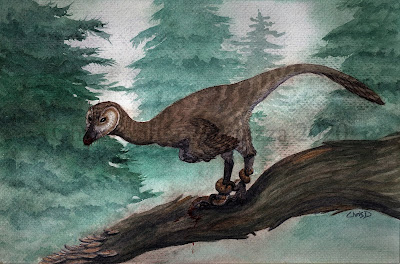
My life reconstruction of Pectinodon bakkeri in watercolors.  These dinosaurs show evidence of having been adept at hunting small prey like mammals and reptiles, including snakes.
My watercolor life restoration of Pectinodon bakkeri.  This animal was likely hunting smaller prey when it was alive, so cretaceous snakes could have been on the menu.

You may recognize Pectinodon by a different genus name, Troodon.  This is because Pectinodon was renamed Troodon during the 1980s.  Then in 2011, after further study, it was split back into its own taxa again.  In fact, the Troodon genus was split up into multiple taxa based on differences in morphology as well as the fact that all these fossils spanned an extremely long amount of time for only one genus of animal to have been living.  The "Troodon" dinosaur that lived during latest Cretaceous in the North American community, called the Hell Creek Formation, was Pectinodon.  The original name is still used to describe the family that all these smaller bird-like dinosaurs came from, Troodontidae.

Even though we don't have too much fossil material from Pectinodon, itself, we can make educated inferences about it based on its closest family members that we have more material from.  The teeth, which we do have, are sharp and possess deep serrations, but only on the edges that faced the back of the mouth.  The teeth are proportionally smaller than those of dromeosaurids, like Velociraptor or Acheroraptor.  Other troodontids are known to have had proportionally large, forward-facing eye sockets, suggesting they had good vision and may have even been able to see well in the dark.  It is this combination of features that lead many to believe troodontids, like Pectinodon, specialized in hunting small prey, like mammals, and small reptiles.

Photograph of one of Pectinodon's teeth.  Note how the anterior has deep serrations.

Pectinodon was likely covered in feathers when alive and probably would have looked like a bird to most of us at first glance if we encountered it today.  Its legs were probably long and slender, which would have allowed it to have run swiftly if it needed to.  This was probably a helpful trait since it would have been pursuing prey as well as avoiding potential predators, like the similarly sized, but more heavily armed, Acheroraptor, and even Tyrannosaurus rex (which was much faster and more agile as a subadult)   Being most active at night is also another way to avoid predation and is a tactic used by many animals today.  

Many animals evolve to be nocturnal to avoid predation.  During the Mesozoic most of the mammals were small and nocturnal to avoid the dinosaurs.  Naturally there will always be some predators that will evolve the same way.  The troodontids likely filled that niche.

Like dromaeosaurids ("raptor" dinosaurs, like Velociraptor, and Deinonychus) troodontids, like Pectinodon also had a retractable "killer claw" on each of their second toes, but theirs weren't as proportionally large as those of dromeosaurids.  This, combined with the traits already mentioned, further point to them specializing in taking much smaller prey.  I imagine troodontids stalking small mammals and reptiles in the thick brush at dusk or at night, using their senses of sight and hearing to zero in, and their long legs to clear tall foliage, then kicking and pinning  their target with their special claws when the time was right, and finally dismembering their meal with their serrated teeth.  Many modern predatory birds execute similar hunting behavior today in various ways.
 
References

Currie, P. (1987). "Theropods of the Judith River Formation". Occasional Paper of the Tyrrell Museum of Palaeontology 3: 52–60.

Holtz, Thomas R., Brinkman, Daniel L., Chandler, Chistine L. (1998) Denticle Morphometrics and a Possibly Omnivorous Feeding Habit for the Theropod Dinosaur Troodon. Gaia number 15. December 1998. pp. 159-166.

Larsson, H.C.E. 2001. Endocranial anatomy of Carcharodontosaurus saharicus (Theropoda: Allosauroidea) and its implications for theropod brain evolution. pp. 19-33. In: Mesozioc Vertebrate Life. Ed.s Tanke, D. H., Carpenter, K., Skrepnick, M. W. Indiana University Press.

Larson D.W., Currie P.J., 2013, "Multivariate Analyses of Small Theropod Dinosaur Teeth and Implications for Paleoecological Turnover through Time", PLoS ONE 8(1): e54329. 

Monday, August 10, 2020

Nigersaurus: Beast of the Week

Nigersaurus taqueti was a sauropod dinosaur that lived in what is now Niger, Africa, during the Cretaceous Period, about 118 to 110 million years ago.  It measured only about thirty feet long which for a sauropod (largest kind of land animal of all time) is actually on the small side.

My reconstruction of Nigersaurus as it unknowingly disrupts a nesting Kaprosuchus. (or something very similar since these two taxa were actually separated by a few million years.)


Nigersaurus
had a unique skull in that its mouth was wide and flat.  The skull actually resembles a vacuum cleaner head to be honest (if you google image search "vacuum cleaner head" and scroll down a bit, a picture of Nigersaurus actually will be one of the results.  No joke go try it).  Inside the mouth were six hundred tiny chisel-shaped teeth, the most teeth in any known sauropod, all lining the front of the mouth.  This arrangement was perfect for clipping low-lying vegetation, like a lawn mower.  Like any dinosaur, whenever one of Nigersaurus' teeth broke off or got worn down, a new one was right underneath ready to take its place.   

Nigersaurus taqueti skeletal mount reconstructed by Tyler Keillor and Stephen Godfrey.  This skeletal mount was unveiled at the National Geographic headquarters in 2007, when Nigersaurus made its public debut.

Nigersaurus had a relatively short neck for a sauropod.  Because of this, combined with the fact that its skull would have been naturally held facing the ground according to how its bones fit together, suggests it specialized in eating low growing plants rather than foliage off trees like some of its longer-necked relatives.  It's also worth noting, that Nigersaurus had eye sockets that were proportionally large and were positioned at the highest point of its skull, when it was in a neutral pose.  When alive you can see that it would have been able to see almost entirely around it at once, and would only need to move its head the slightest bit to either side, in order to see directly behind it or in front of it.  This may be an adaptation to keep lookout for predators without having to stop eating.  Since sauropods weren't particularly fast runners, Nigersaurus may have used its long tail as a weapon, or perhaps lived in herds for protection


Close up of Tyler Keillor's Nigersaurus skull.  You can really get a idea of how unique and specialized this dinosaur truly was!

Special thanks to paleo-artist, Tyler Keillor for allowing me to use images of his awesome skeletal reconstructions.  As always if you have a dinosaur or other prehistoric creature you would like to see covered comment below or let me know on twitter or facebook!

References

Sereno PC, Wilson JA, Witmer LM, Whitlock JA, Maga A, et al. (2007) Structural Extremes in a Cretaceous Dinosaur. PLoS ONE 2(11): e1230. [1] doi:10.1371/journal.pone.0001230.

Wilson, J. A. and Sereno, P. C. (2005). "Structure and Evolution of a Sauropod Tooth Battery". In Curry Rogers, K., and Wilson, J.A. (eds.), The Sauropods: Evolution and Paleobiology, University of California Press, Berkeley, ISBN 0-520-24623-3.

Monday, August 3, 2020

Anodontosaurus: Beast of the Week

This week we will be looking at a heavily-armored dinosaur.  Check out Anodontosaurus!

Anodontosaurus was an armored dinosaur in the ankylosaurid family that lived in what is now Western Canada, between 74 and 67 million years ago.  From snout to tail it measured about 20 feet long, and would have eaten plants when alive.  The genus name translates to "Toothless Lizard/Reptile" because it was originally thought to have been toothless. (but it wasn't). There are two named species within the genus.  The first discovered of the two was Anodontosaurus lambei, which lived later, while earlier-living species by a few million years was named Anodontosaurus inceptus

My life reconstruction of Anodontosaurus lambei in watercolors.  

Anodontosaurus, like most ankylosaurids was covered on the top side of its body with bony armor, called osteoderms.  These chunks of bone grew out from the skin, and many were keeled, and slightly triangular in shape.  Over its hips it possessed a sacral shield, a sheet of bone studded with osteoderms, growing over its hips.  Its skull was adorned with short broad horns above the eyes and lining the back of the head, as well as longer, broader horns growing out from under its eyes.  It had a wide beak at the front of the mouth and its jaws were lined with small teeth ideal for processing plants.  At the time of its discovery, however, because the skull as crushed in such a way after the animal's death, causing the teeth to fall out, scientists initially believed it was toothless in life.

After its initial discovery and naming Anodontosaurus was later lumped into the genus with another ankylosaurid relative, Euoplocephalus, thus losing its genus name.  However, in 2010, it was re-examined more closely and once again deemed different enough for its own genus, in a study led by paleontologist, Victoria Arbour.  The main reasons why the genus was split was because Anodontosaurus' horn arrangement, neck armor, and tail club were different from those of Euoplocephalus, and a few other ankylosaurids, which were also given their own genus from the study.  Anodontosaurus' tail club was unique in that it was elongated and pointed on either end, while Eouplocephalus' club is a smoother oval shape.

Cast of Anodontosaurus tail club on display at the American Museum of Natural History in New York.

Like all ankylosaurids, Anodontosaurus would have relied on its armor and tail club, which could be swung from side to side very powerfully, for defense against predators, like tyrannosaurids.  It is also very possible that ankylosaurids engaged in combat within the species, possibly smashing each other with their clubs, as well.  Anodontosaurus' tail club looks particularly wicked, since it comes to a point on either side, concentrating all the force onto a smaller surface when swung.  I'd imagine getting hit by Anodontosaurus would be more like being pummeled with a hammer than a club.  Ouch.

References

Arbour, Victoria (2010). "A Cretaceous armoury: Multiple ankylosaurid taxa in the Late Cretaceous of Alberta, Canada and Montana, USA". Journal of Vertebrate Paleontology30(Supplement 2): 55A.

Arbour, V. M.; Currie, P. J. (2015). "Systematics, phylogeny and palaeobiogeography of the ankylosaurid dinosaurs". Journal of Systematic Palaeontology14 (5): 1–60.

C. M. Sternberg (1929) "A toothless armoured dinosaur from the Upper Cretaceous of Alberta." Canada Department of Mines Geological Survey Bulletin (Geological Series)54(49):28-33

Coombs, W.P., Jr. (1986, June). A Juvenile ankylosaur referable to the genus euoplocephalus (reptilia, ornithischia). Journal of Vertebrate Paleontology, 6(2), 162-173.

Penkalski, P. (2013). "A new ankylosaurid from the late Cretaceous Two Medicine Formation of Montana, USA"Acta Palaeontologica Polonica.

Monday, May 4, 2020

Stellasaurus: Beast of the Week

This week we'll be checking out a newly described ceratopsian dinosaur.  Say hello to Stellasaurus anchellae!  Stellasaurus lived in what is now Montana, USA, during the late Cretaceous period, about 75.2 million years ago.  From beak to tail it measured about 20 feet long and would have eaten plants when alive.  The genus name, Stellasaurus, translates to "Star Lizard" due to its flamboyant horn ornamentation and in honor of the late rockstar, David Bowie, and his song, "Starman".

My life reconstruction of Stellasaurus done in watercolors.  Ziggy Stardust-style facial markings and body stripes may have been an adaptation to communicate with members of its own species.  (Nature has produced weirder things.)

Stellasaurus is characterized by having a massive nose horn that curved backwards, towards the tail end of the animal, much like the horn of a modern rhinoceros.  Stellasaurus' nose horn was also slightly laterally compressed, like a blade, rather than having a more rounded cross-section, which is unusual for ceratopsians.  Finally, this dinosaur sported two long, upwards-facing horns on either side of its frill.  The evolutionary purpose of these horns was likely for some sort of intraspecies communication, likely display and/or combat with rivals.  Because there is just so much variation in headgear amongst ceratopsian species, it is unlikely they were purely for defense against predators.  Stellasaurus was a member of the centrosaurine group of ceratopsians, which are characterized by their deeper snouts and proportionally smaller neck frills.

Right and left views of Stellasaurus' massive rhinoseros-like nose horn. (image from Wilson's 2020 paper linked below)

There are a lot of ceratopsian taxa on the fossil record.  New members of this wildly successful group of dinosaurs are being published every year.  That being said, Stellsasaurus is a particularly important find because it appears to help show an actual evolutionary line in action.  We know evolution is an ongoing process of older forms of organisms changing over time into newer forms in response to environmental changes.  That being said, it isn't common to be able to say with certainty one taxa was a direct ancestor or descendent of another in the fossil record.  However, looking at the frill horns of Stellasaurus, and then comparing them to the frill horns of other ceratopsians that lived in the same place as it from different times, paleontologists were able to see a likely linear transition between at least five different kinds of ceratopsians!

Left and right sides of Stellasaurus' frill and frill horns.  Note how it has two growing from each side.  (Image from Wilson's 2020 paper linked below.)
A close relative of Stellasaurus, Styracosaurus, which lived slightly earlier than Stellasaurus, had similar frill horns, but they were more numerous, with three on each side instead of Stellasaurus' two.  Einiosaurus, which lived a bit after Stellasarus, only had one of these frill horns on each side.  The even younger Achelousaurus, also had two horns on its frill, but they angled slightly outwards.  Finally, the youngest piece to the puzzle, Pachyrhinosaurus, also had these horns, but they were even more dramatically curved outwards.  The only thing that may not seem to match up is the difference in nose ornamentation between Stellasaurus' backwards curving horn, and Einiosaurus' extremely forward-facing horn, but keep in mind there were millions of generations of dinosaurs between these individuals, and therefore many more transitional forms that existed there.  Maybe we'll find yet another ceratopsian to fit into this line to make it even more detailed!

Stellasaurus provides a crucial puzzle piece in showing a possible direct transitional line among several different taxa of centrosaurine ceratopsians.

That is all for this week.  As always please leave your thoughts below!

References

Wilson, John P.; Ryan, Michael J.; Evans, David C. (2020). "A new, transitional centrosaurine ceratopsid from the Upper Cretaceous Two Medicine Formation of Montana and the evolution of the 'Styracosaurus-line' dinosaurs"Royal Society Open Publishing7 (4).

Thursday, April 23, 2020

Bird Feeders: Sharing Our Earth with Wildlife

This Earth Day I want to focus on birds.  Birds are by far the most successful vertebrates on land today.  They outnumber all other vertebrates, including us, mammals, in terms of species diversity, as well as in sheer numbers.  With this in mind, paired with the fact that birds are dinosaurs, you could say the "age of dinosaurs" people often think ended millions of years ago, is still going stronger than ever.  A great way to see a wider variety of live dinosaurs without even leaving your home is by setting up a bird feeder.  Feeders come in a variety of sizes and types and can be set up even on windows of small apartments if need be.  I put together a list of thoughts to remember that I hope will help you get the most out of your bird feeder.

A Tufted Titmouse (left) and female Downy Woodpecker (right) sharing a meal at our feeder.  

Tip 1: Feeding wildlife is dangerous.

First off, I want to make it clear that most of the time it is an absolutely terrible idea to feed wildlife.  Normally when this happens, wild animals learn to associate humans with food, and therefore will start seeking humans out instead of foraging for food, themselves, like they naturally would be.  This is how you get what are referred to as "problem animals", like deer, bears, or even alligators, that lose all fear of humans and start living way to close to people for comfort.  Sadly these animals are often humanely killed by local authorities because they start posing a threat to people.  In addition to this, well-meaning people often feed wildlife inappropriate foods that don't meet the animal's nutritional needs, and in some cases actively hurt the animals.  Feeding bread to ducks, for instance, is actually detrimental to the ducks since they can't digest it and it can lead to developmental problems.

Snow White was super inappropriate when it came to interacting with wildlife.  Don't be like Snow White. 

Tip 2: Wildlife Still Needs Our Help.  It just needs to be given the right way.

Hold on...I started by saying I was going to tell you how to set up a bird feeder...but then said feeding wildlife is bad?  Which is it!?  Let me explain.  Bird feeders are a little different from blatantly throwing food at animals outside since in the case of bird feeders, the wildlife never associates the food with humans.  As far as the birds know you and the food you put out are completely unrelated.  This fact, paired with the assumption that the quality of food you're providing the birds is appropriate and adds to, not replaces, their wild diet (which we will cover below), results in a totally safe scenario for all parties, with some added food available for the birds, and entertainment for you!  I'm a firm supporter of the idea that wildlife should stay wild.  However, I also completely support the idea of humans actively helping protect and preserve wildlife when it's needed and if it's done appropriately.  Wild bird numbers have been consistently dropping at an alarming rate and it's absolutely in response to human activity, predominantly pollution, habitat destruction, and climate change.  So putting a bird feeder out is a small way to maybe help some wild birds get some extra energy and nourishment in their already stressful daily lives living in the wild.

Tip 3: The variety of animals present is entirely dependent on the habitat available.

In order for wildlife to be present there must be a habitat.  It sounds like a no-brainer, but it's important to keep in mind. The kinds of birds that will come to your feeder will depend on the kind of habitat you are currently near.  That being said keep in mind that urban areas with lots of human development are absolutely habitats for wildlife, too.  I have seen lots of really interesting species that make their homes in highly populated cities.  If you do live on a property where you have a yard and the ability to control the kinds of plants and landscaping that's present, you can change the habitat and possibly attract more species over time.

Habitats are less restricted by space than you think.  This is important especially if you live in a small home with no yard, or in an apartment.  This doesn't mean you can't still provide at least a small change to make your home a little better for wildlife.  Many flowers and other native plants do just fine in potted plants that can exist on windowsills.  Bird feeders that attach directly to windows via suction cups are easy to find and purchase.  My point is no matter what kind of home you live in, attracting more wildlife is always possible.

Eastern Bluebirds only nest in meadows and fields, so if you don't have a space like that nearby, you are unlikely to see them very often.  I took this photo miles away from my house because I don't have the right habitat near my property for this species.

Tip 4: Insect protein is essential for nutritious bird feeders.

The more variety in food is in your feeder, the more variety in wildlife you'll attract.  Lots of people simply buy a bag of seeds to fill their feeders.  If you really want to attract more species of birds, as well as provide them with more useful nutrients, make sure your bird feeders have insects in them!  Keep in mind that in the wild, many songbirds eat a lot of insects.  In fact, songbirds, even the ones that are often associated with eating seeds and fruit, are one of the strongest forces that control insect populations in the world, alongside bats and amphibians.  Luckily any garden store, or other place that already sells wild bird seed, will have bags of dried mealworms that you can mix into your feeder.  Some bird feed companies also make bags that include both seeds and insects together.

Downy Woodpeckers, like all woodpeckers, eat insects year round.  A suet block, like the one this male is feeding from, is essentially a powerbar for birds, loaded with protein from both ground nuts and insects.  

Tip 5: You don't need to hate on squirrels so much.

I see people often complaining that they get too many squirrels eating out of their bird feeders. I've even witnessed many people state they actively avoid setting up bird feeders because they're so turned off by the squirrels.  Where I live we have Eastern Gray Squirrels.  They're extremely common, but they're still native, and therefore a part of the natural environment.  They help plant trees by burying seeds and nuts (and forgetting to retrieve them) as well as provide a valuable food source for many charismatic predators, like hawks and owls.  In addition, even though it may seem like squirrels are hogging all the bird seed, I assure you the birds are still getting meals out of the feeder.  That being said if you still want to reduce the frequency of squirrel feeding and increase that of birds, many bird feeders have mechanisms that (somewhat) deter squirrels built into them, like perches that collapse under the weight of a squirrel, but not a bird.  You can also buy bird seed that has hot peppers in it which squirrels don't like, but birds do.  That's right.  birds have different taste receptors from mammals, including the inability to register capsaicin, the chemical that makes you feel like your mouth is on fire when you eat spicy food.  (When I was a zookeeper the cockatoos LOVED to snack on chili peppers.)

The neighborhood we live in has a high concentration of melanistic Eastern Gray Squirrels.  Melanism is when an animal is born with more melanin, the pigment that makes skin and hair darker.  


Tip 6: Clean your bird feeder between fillings.

When your bird feeder is empty, scrub it thoroughly with soap and water and let it air dry for a day before you fill it up again.  Old food residue will start to harbor bacteria and fungus that will make birds sick when they use the feeder.  Not letting the feeder dry all the way before filling will also grow fungus that can be harmful to birds.  Same goes for hummingbird feeders.

This is a male and female Eastern Goldfinch that visits our feeder almost every day.  This photo was taken in early March, and you can see the male wasn't quite shedding away all of his brown winter feathers for his bright yellow mating season feathers.  The female, although more drab than the male, also turns more yellow in the warmer months. 


Tip 7: Don't be surprised if your bird feeder becomes a bird feeder... feeder.

By this I mean that if you have songbirds visiting your feeder enough, their predators will start to hang around too for obvious reasons.  Since putting up my feeder this past winter, I see the local Coopers Hawk and a young Red-Shouldered Hawk showing up more often.  As with the squirrels, some people don't like birds of prey at their feeders because they feel bad for the pretty songbirds that are at the feeder.  In my opinion it is important to keep in mind that regardless how cute these little birds are, they are still an active piece in the local ecosystem, and being food for a predator is an inevitable and necessary fate for some of them.  After all, the predators need to eat too.

Predators of songbirds, like the Barred Owl I photographed in October, are a necessary part of any ecosystem.  Owls especially also heavily control rodent populations.

Tip 8: KEEP YOUR CATS INDOORS!!!

There is literally no positive aspect of having an outdoor cat.  None.  Not for the cat, and certainly not for any wild animals that now have to share space with the cat.  A recent scientific study came out that proves just how many birds and other native animals domestic cats really kill and the numbers are horrifying.  It's estimated that domestic cats are responsible for the deaths of BILLIONS of wild birds per year.  Billions.  With a B.  That's more bird deaths than by window collisions!  Some might argue that an outdoor cat is simply part of the environment and doing its part as a predator.  This opinion is extremely wrong for a few reasons.  First of all, domestic cats are originally native to Northern Africa, from where they spread to there rest of the globe with humans as pets, and therefore have no business in most ecosystems where they're killing birds.  So this is why outdoor cats are such a problem, but the birds of prey that also kill small birds I previously mentioned, are not.  Second, even if you were to try to reason that cats are taking the place of other predators that previously lived in these areas before humans developed over them, like bobcats, you'd still be wrong.  This is because one bobcat can have a territory that stretches for several miles which they will defend from other bobcats violently.  Plus, although Bobcats do eat birds naturally, they don't kill them nearly as frequently as one domestic cat does.  Domestic cats also aren't nearly as territorial so many individuals can be roaming the same small space, and since they're often being fed by their humans anyway, they're killing birds out of instinct/play, not to survive.  Another important point is that being outdoors unsupervised is extremely dangerous for the cat, as well.  Typical lifespans of cats that are allowed to roam outdoors are significantly shorter than those of cats that stay indoors.  They're exposed to parasites, fleas, all sorts of diseases, and of course are at risk of being killed by cars and even wild predators, like coyotes and even large birds of prey.  If you're a cat owner like me, you can keep your cat perfectly happy indoors with toys and plenty of attention in the form of play sessions with you, the owner.  You can also totally get your cat used to a leash for outdoor adventures that is safe for both the cat and the local wildlife.

One of our cats, Beaker, wasn't a fan of the leash at first, but now she loves her (wildlife-safe) outdoor adventures.

Tip 9: Citizen Science is fun.

Citizen science is when amateurs or non-professionals participate and contribute to scientific research.  This can take lots of forms, like volunteering at your local nature center to help gather data on local wildlife populations.  However, some citizen science can be done without even leaving your house, like something as simple as counting the number of birds that visit your feeder.  Free apps like ebird and iNaturalist allow you to document bird numbers and species as you see them, and scientists can use that data for their research.  Not able to identify every bird that you see?  No problem!  Both these apps have features that actually help you identify mystery animals in real time, so you're learning to identify local wildlife you share your home with, too.  It's also fun to rack up as many bird species as possible and compare to other folks doing the same thing in their homes!

Northern Cardinals, like this female who visited our feeder yesterday, use their powerful beaks to crack open shells of nuts.
I hope this list of tips helped inspire you to start your own bird feeder.  If you already have a feeder I'd love to know what kind of visitors you're getting.  I personally have spotted a total of 28 species at my feeder since setting up this past winter.  Share your species count or the coolest bird you've seen on your property in the comments below!