Sunday, February 26, 2023

Balaenognathus: Beast of the Week

This week we'll be checking out a very unusual little pterosaur, Balaenognathus maeuseri! 

Balaenognathus was a pterosaur that lived in what is now Germany during the late Jurassic period, between 157 and 145 million years ago.  It was relatively small for a pterosaur, with a wingspan of a little under 4 feet (1.17 meters) from wingtip to wingtip. The genus name translates to "Bowhead whale jaw" after the modern Bowhead whale, one of many kinds of whale that sports structures called baleen in its mouth for filter-feeding on tiny animals.  When alive it is likely Balaenognathus fed on tiny animals in the water with the help of its specialized teeth.

Watercolor life reconstruction of Balaenognathus by Christopher DiPiazza.

Balaenognathus' most distinctive feature is its face, with a long, thin snout that curved slightly upwards toward the tip then flared out in an almost square shape at the very end.  The sides of both the upper and lower jaws were lined with hundreds of extremely thin teeth that were also hooked at the ends.  This appears to be an adaptation for capturing tiny creatures out of the water, much like the baleen of many modern whales.  Many birds, like flamingos and some ducks and geese, also sport structures similar to this in their mouths for filtering food from the water, but not to the extent that Balaenognathus had.  Even stranger is that Balaenognathus had a bony keel that extended from the roof of its mouth downward, which would have prevented it from closing its mouth completely.  This could also have something to do with a filter-feeding lifestyle, since the tips of the teeth could still overlap despite this feature.  

Flamingos and baleen whales, like the Bowhead whale, both independently evolved structures in their mouths to filter tiny animals for food.  Ctenochasmatids, like Balaenognathus, also independently evolved a similar feature for a similar feeding strategy.

Balaenognathus was a member of the family of pterosaurs, called ctenochasmatids, which are characterized by having relatively long necks and long skulls, lined with teeth.  Many members of this group appear to have had unique teeth for filter feeding on small prey in the water, which makes sense since all members of this group are mostly found in areas that would have had an abundance of water when they were alive.  What is interesting, however, is that no two members of this group have extremely similar kinds of filter-feeding teeth, implying they were eating similar prey in life, but probably were going about it in different ways with regards to their postures and movement.  Pterodaustro is an example of another kind of ctenochasmatid pterosaur that also sported baleen-like teeth, but in a different arrangement from Balaenognathus.

Photo of the fossilized skeleton of Baelenognathus.  Because of how complete and well-preserved it is, paleontologists were able to learn a lot about this unique pterosaur.

That's all for this week!  As always feel free to comment below or leave a request fora. future prehistoric beast to cover!

References

Martill, David M.; Frey, Eberhard; Tischlinger, Helmut; Mäuser, Matthias; Rivera-Sylva, Héctor E.; Vidovic, Steven U. (2023-01-21). "A new pterodactyloid pterosaur with a unique filter-feeding apparatus from the Late Jurassic of Germany". 

Sunday, January 15, 2023

Regaliceratops: Beast of the Week

 This week we will be checking out a ceratopsian with unique and beautiful ornamentation.  Make way for Regaliceratops peterhewsi!

Regaliceratops was a ceratopsian dinosaur that lived in what is now Alberta, Canada, during the late Cretaceous period between 69 and 67 million years ago.  It is estimated to have measured about 16 feet (5 m) long and would have eaten plants when alive.  The genus name translates to "Regal Horned Face" because of the arrangement of horns around the edge of its frill resembles a crown.  The species name, peterhewsi, honors the geologist, Peter Hews, who initially discovered its remains.  Before it was officially named, Regaliceratops was casually nicknamed "Hellboy" by the paleontologists excavating and prepping its fossils because it was a particularly difficult job due to the unfavorable geology and intricate details of the skull they had to work around without damaging the specimen.  (not necessarily after the comic book character, Hellboy, even though the dinosaur and the character both have horns...which don't actually resemble each other anyway.)

Regaliceratops reconstruction in watercolor by Christopher DiPiazza.

Regaliceratops had a circular frill which was adorned with a row of flat, almond-shaped horns growing from its perimeter, including one in the middle, which is unusual since most ceratopsian frill ornamentation is paired on either side of the frill.  The center horn also is keeled down its midline, another unusual trait for ceratopsian ornamentation.  Regaliceratops had a relatively long horn growing from the top of its snout, and a small, narrow, forward-curving horns over its eyes.  As is the case with most ceratospians, experts think this elaborate headgear was connected to some kind of communication within the species, and possibly for combat within the species.  This doesn't mean a ceratopsian wouldn't have used its horns to defend itself against predators, but the drastic diversity from species to species over time in ceratopsian headgear suggests they were being selected for something more display-related.  If they were primarily for defense it would be more expected for them to be more similar to each other. (like ankylosaur armor or stegosaur tail spikes)

Skull of Regaliceratops on display at the Royal Tyrrell Museum in Alberta, Canada. Photo credit Sue Sabrowski.
 
Regaliceratops is considered part of the chasmosaurine line of ceratopsians, which typically had longer frills, longer brow horns, and shorter nose horns.  Regaliceratops mostly goes against this trend having a long nose horn and short brow horns with a relatively shorter frill.  Similarities in other parts of the skull, however, to chasmosaurines, especially Triceratops, confirms Regaliceratops was indeed most closely related to them.  

When alive, Regaliceratops would have shared its habitat with other dinosaurs, like the ankylosaur Anodontosaurus, fellow ceratopsian, Pachyrhinosaurus, and the small predator, Atrociraptor.  It also would have needed to look out for the largest known predator of the area, the tyrannosaurid, Albertosaurus. 

References

Brown, Caleb M.; Henderson, Donald M. (June 4, 2015). "A new horned dinosaur reveals convergent evolution in cranial ornamentation in Ceratopsidae". Current Biology. 25 (12): 1641–8.

B. Weishampel, David; M. Barrett, Paul; A. Coria, Rodolfo; Le Loeuff, Jean; Xing, Xu; Xijin, Zhao; Sahni, Ashok; P. Gomani, Elizabeth M.; R. Noto, Christopher (2004). "Dinosaur Distribution". In Weishampel, D.B.; Dodson, P.; Osmolska, H. (eds.). The Dinosauria 2nd edition. pp. 517–606.

Sunday, January 8, 2023

Thescelosaurus: Beast of the Week

 This week we will be looking at a little dinosaur that definitely deserves more attention.  Check out Thescelosaurus!

Thescelosaurus was a relatively small plant-eating dinosaur that lived in what is now North America, during the latest part of the Cretaceous period, between 68 and 66 million years ago.  From beak to tail the largest specimens were almost 15 feet (4.5 meters) long.  The genus name translates to "godlike lizard/reptile" in reference to how surprised scientists were at how well preserved and complete the first studied specimen's bones were.  Thescelosaurus and its closest relatives were long thought to be part of the ornithopod group of dinosaurs. (includes more famous members like Iguanodon) More recently, however, paleontologists have found that Thescelosaurus' lineage branched off earlier than the oldest true ornithopods, despite being physically similar in appearance to them. (that being said as more information is learned about dinosaurs, this part of the family tree could change again for all we know.)

Watercolor reconstruction of Thescelosaurus neglectus by Christopher DiPiazza.

Thescelosaurus is currently known from three species, Thescelosaurus neglectus, which was the first named and lived in the United States, named after the fact that the specimen was kept in a box for years until it was formerly examined for the first time. Thescelosaurus garbanii was also from the United States but was slightly larger and more robust.  Thescelosaurus assiniboiensis was the smallest of the three species and lived in what is now Western Canada.  When alive, Thescelosaurus would have shared its environment with famous dinosaurs, like Tyrannosaurus, Triceratops, Pachycephalosaurus, Acheroraptor, and Edmontosaurus.

In general Thescelosaurus is characterized by being a pretty robust dinosaur, despite the fact that it wasn't overall a very large.  It would have walked on its hind legs, but some suggest it could have possibly moved or rested on all fours at least some of the time.  Its front limbs were relatively long and strong, and tipped with five fingers on each hand.  It had a flexible neck and a proportionally small skull with a narrow beak in the front of its jaws and teeth lining the sides ideal for shredding plants once inside the mouth. This dinosaur also had teeth at the tip of its snout, where the beak was, which may have helped it strip leaves off of stems and shoots as it ate.

Thescelosaurus skeleton on display at the Canadian Museum of Nature in Ottowa, Ontario, Canada.

Some Thescelosaurus also had overlapping bony plate-like structures on their ribs.  At first some believed these were to aid in breathing but they lack the sort of surface texture that normally would imply there were muscles attached in life.  Thanks to specimens of Thescelosaurus that weren't quite mature when they died, we know these plates may have started as cartilage and would have solidified into bone as the animal aged.  Perhaps they provided extra protection in some sort of intraspecies combat only mature individuals engaged in?  

Thescelosaurus skeletal mount on display at the Smithsonian National Museum of Natural History.  Note the bony rib plates. 

Most recently, research led by paleontologist, Clint Boyd, uncovers more than one Thescelosaurus specimens had a pair of bony, knob-like spurs growing out of each of their forearms.  These features have only been found in mature individuals so far, and therefore imply they may have been used in some sort of display or combat between rivals within a species.  This connects really nicely with the rib plates previously mentioned and it is easy to imagine two rival males squaring up and using their arms like studded maces to smash each other in the flanks, or even bear-hugging each other, over territory or mating rights.  

Watercolor reconstruction of two rival Thescelosaurus using arm spurs in combat by Christopher DiPiazza.

We also have Thescelosaurus specimens that preserved skin patches thanks to being naturally mummified after death.  Thanks to this find we know that Thescelosaurus had scaly skin on at least some of its body!  

That is all for this week!  As always feel free to comment below!

References

Boyd, Clint A.; Cleland, Timothy P. (2008). "The morphology and histology of thoracic plates on neornithischian dinosaurs". Abstract with Programs - Geological Society of America; Southeast Section, 57th Annual Meeting. 40 (2): 2.Boyd, Clint A.; Brown, Caleb M.; Scheetz, Rodney D.; Clarke, Julia A. (2009). "Taxonomic revision of the basal neornithischian taxa Thescelosaurus and Bugenasaura". Journal of Vertebrate Paleontology. 29 (3): 758–770. 

Brown; Caleb M.; Boyd, Clint A.; and Russell, Anthony P. (2011). "A new basal ornithopod dinosaur (Frenchman Formation, Saskatchewan, Canada), and implications for late Maastrichtian ornithischian diversity in North America". Zoological Journal of the Linnean Society. 163 (4): 1157–1198. 

Brown, Caleb Marshall; Evans, David C.; Ryan, Michael J.; Russell, Anthony P. (2013). "New data on the diversity and abundance of small-bodied ornithopods (Dinosauria, Ornithischia) from the Belly River Group (Campanian) of Alberta". Journal of Vertebrate Paleontology. 33 (3): 495–520. 

Galton, Peter M. (1995). "The species of the basal hypsilophodontid dinosaur Thescelosaurus Gilmore (Ornithischia: Ornithopoda) from the Late Cretaceous of North America". Neues Jahrbuch für Geologie und Paläontologie, Abhandlungen. 198 (3): 297–311. 

Galton, Peter M. (1997). "Cranial anatomy of the basal hypsilophodontid dinosaur Thescelosaurus neglectus Gilmore (Ornithischia; Ornithopoda) from the Upper Cretaceous of North America". Revue Paléobiologie, Genève. 16 (1): 231–258.

Stein, Walter W. “The Paleontology, Geology and Taphonomy of the Tooth Draw Deposit; Hell Creek Formation (Maastrictian), Butte County, South Dakota. .” The Journal of Paleontological Sciences, Apr. 2021, pp. 1–108.


Sunday, December 4, 2022

Albertosaurus: Beast of the Week

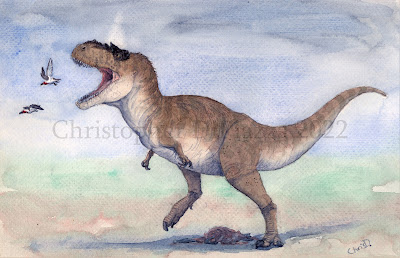
Albertosaurus sarcophagus was a large meat-eating dinosaur, that lived in what is now Alberta, Canada, and possibly parts of the USA, including Montana, Wyoming, and New Mexico, during the late Cretaceous period between 71 and 68 million years ago.  From snout to tail the largest adults would have measured 30 feet (about 9 meters) long.  The genus name translates to "Alberta Reptile" in reference to Alberta, the province in Canada where its bones have been found.  The species name is derived from the Greek term, sarkophagos, which translates to "flesh eater".

Albertosaurus sarcophagus life reconstruction in watercolor by Christopher DiPiazza.

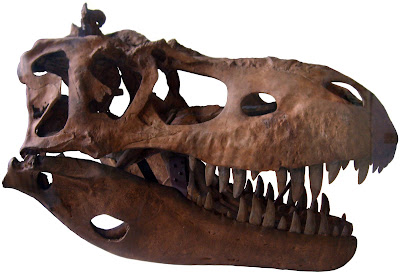
Albertosaurus was a member of the tyrannosaurid family of theropod dinosaurs.  Like other members of this group, it possessed a proportionally large skull with forward-facing eye sockets, large curved, serrated teeth on the sides of its jaws and narrow teeth in the front of its mouth with a D-shaped cross section, horn-like crests over the eyes and snout, proportionally long legs, and proportionally short arms with two fingers on each hand.  Tyrannosaurus is by far the most famous member of this group, but Albertosaurus was the most closely related to Gorgosaurus.  In fact Albertosaurus and Gorgosaurus are almost indistinguishable in many ways to the point where a few have proposed they should belong in the same genus.

We actually know a lot about Albertosaurus compared to most fossil dinosaurs due to the unusually high number of individuals that have been found.  Even more impressive, the majority of these Albertosaurus specimens are actually all from the same site, called the Dry Island Bone Bed, in Alberta, Canada, which includes at least 12 (but potentially over 20) individual animals. This group comprises of Albertosaurus skeletons of varying sizes/ages that all appeared to have died at roughly the same time. Many paleontologists think this discovery also suggests that Albertosaurus may have been social, perhaps even pack hunters, when alive.  Others say they could have simply been congregating around a river or lake bed during a drought and died of thirst together. 

Because so many Albertosaurus of different sizes have been discovered, paleontologists were able to compare the different sizes and ages of the various specimens and map out how Albertosaurus grew.  Like other known tyrannosaurids we have juvenile specimens from, we know Albertosaurus was extremely lightly built, with proportionally long legs when it was younger.  It would get bulkier and more robust as an adult.  We also know most tyrannosaurids grew very rapidly in the beginning of their lives, reaching close to adult size at around 15 years old.  From there, they would continue to grow but at a much slower pace.  This observation has led many paleontologists to propose that tyrannosaurids filled multiple different predator roles in their ecosystems as they aged, specializing in hunting smaller faster prey, like smaller fast-running theropods and ornithopods, when younger, then graduating to hunting larger bulkier prey, like hadrosaurs, ceratopsians, and ankylosaurs, when they were more mature.  

Albertosaurus skull cast on display at the Copenhagen Geological Museum.

Recently fossils from what appear to be a hatchling Albertosaurus were unearthed.  A tiny toe bone and tooth thought to be from a tyrannosaurid from the same area Albertosaurus fossils are known from were presented to the public in 2021.  Despite only being two parts, they possessed features that paleontologists were able to deduct as only being from a tyrannosaurid.  Previous to this discovery, baby tyrannosaurs this small were a total mystery.  It is still a mystery why they are so rare, but these few baby bones could certainly help us understand them better!

When alive, Albertosaurus would have been a top predator in its community.  It would have coexisted with (and probably ate) other dinosaurs, like Hypacrosaurus, Pachyrhinosaurus canadensis, Sphaerotholus, Anodontosaurus, and Atrociraptor.  

References

Eberth, David A.; Currie, Philip J. (2010). "Stratigraphy, sedimentology, and taphonomy of the Albertosaurus bonebed (upper Horseshoe Canyon Formation; Maastrichtian), southern Alberta, Canada". Canadian Journal of Earth Sciences. 47 (9): 1119–1143.

Erickson, Gregory M.; Makovicky, Peter J.; Currie, Philip J.; Norell, Mark A.; Yerby, Scott A.; Brochu, Christopher A. (2004). "Gigantism and comparative life-history parameters of tyrannosaurid dinosaurs" (PDF). Nature. 430 (7001): 772–775.

Funston, Gregory S (2021) "Baby tyrannosaurid bones and teeth from the Late Cretaceous of western North America" Canadian Journal of Earth Sciences. 454

Holtz, Thomas R. (2004). "Tyrannosauroidea". In Weishampel, 


Sunday, November 20, 2022

Beipiaosaurus: Beast of the Week

 Beipiaosaurus inexpectus was a theropod dinosaur that lived in what is now Liaoning, China, during the early Cretaceous period, 125 million years ago.  From snout to tail it measured about 7 feet (2.2 meters) long and would have eaten plants when alive.  The genus name means "Beipiao Reptile" which is in reference to the city, Beipiao, near where its fossils were discovered.  

Watercolor reconstruction of Beipiaosaurus by Christopher DiPiazza.  Note the combination of shorter, shaggy feathers and long, quill-like feathers.

Beipiaosaurus was an early member of the therizinosaur group of theropods, which are famous for being herbivores in an otherwise mostly meat-eating group.  They are also known for having proportionally short legs and long arms, equipped with three extremely long claws on each hand.  Later therizinosaurs, like the more famous, Therizinosaurus, are known for having long, slender necks with proportionally tiny heads, but Beipiaosaurus actually had a very large head, with a skull the same length as its femur.  Beipiaosaurus also had three weight-bearing toes on each foot, while its later relatives had four. 

Beipaosaurus had a long, narrow skull, with a small beak at the tip that was also lined with small leaf-shaped teeth, ideal for shredding plants.  It had long, powerful arms, each equipped with three extremely large, hooked claws.  Since Beipiaosaurus appears to have been a plant-eater, these claws could have been for manipulating branches as it ate, or possibly even for defense against predators.  Thanks to beautifully preserved remains, we know that Beipiaosaurus was mostly covered in shaggy, fur-like feathers that could have been an adaptation to keep the dinosaur warm. (the climate where it lived during the early Cretaceous could get cold at times)  Beipiaosaurus also had a second kind of unusual long, quill-like feather that appear to have been growing out of its body amongst the shorter, shaggier feathers.  We don't know exactly what these quill-like feathers were for. Perhaps they helped keep the animal dry by wicking off rain, or possibly they were for some kind of display among members of the same species? It's difficult to tell without seeing the animal alive. Beipiaosaurus also had a bone on the tip of its tail, called a pygostyle, which modern birds also have where their tail feathers attach.  Beipiaosaurus doesn't show any evidence of those kinds of feathers, however, so the bone, itself, must have evolved first.

Fossil Beipiaosaurus.  Note the feathers that preserved around the neck.

Perhaps the most amazing discovery about Beipiaosaurus, however, is that scientists were able to figure out what colors its feathers were in life.  Be examining the fossilized feathers from Beipiaosaurus' neck under a special kind of microscope, they were able to see cell structures, called melanosomes, which can determine the color of a feather according to the their shape.  Then they compared the shape of Beipiaosaurus' melanosomes to those of living birds and looked for matches.  The modern bird feathers that matched Beipiaosaurus' melanosomes the most were brown, so we can confidently assume that at least some Beipiaosaurus had brown feathers on their necks in life.  

Scientists also found patches of Beipiaosurus' skin!  By looking at its skin under a microscope and then comparing it to other animals, they were able to determine by the amount of keratin (material that feathers, hair, and nails are made of) in the cells, that Beipiaosaurus' body wouldn't have radiated as much heat as many modern birds.  They also were able to determine that Beipiaosaurus would have shed its skin more like modern birds, as dandruff, rather than other kinds of reptiles, like lizards, which shed skin in large pieces or flakes.  (fun fact: modern crocodilians also shed their skin as dandruff!)

Close up of a patch of Beipaosaurus skin from McNamara's 2018 paper.

Before Beipiaosaurus was discovered in 1996, the exact placement of therizinosaurs on the dinosaur family tree was more debated.  Originally, some paleontologists thought they were late-surviving descendants of the early sauropodomorphs from the Triassic and early Jurassic, like Plateosaurus, based on similarities with their small leaf-shaped teeth, long necks, wide bodies, and robust legs.  The discovery of Beipiaosaurus, however, which has more obvious theropod traits while clearly showing a direct connection to the more outlandish, later therizinosaurs, confirms therizinosaurs were indeed theropods.  

That's all or this week!  As always feel free to comment below!

References

Li, Q.; Clarke, J. A.; Gao, K.-Q.; Zhou, C.-F.; Meng, Q.; Li, D.; D’Alba, L.; Shawkey, M. D. (2014). "Melanosome evolution indicates a key physiological shift within feathered dinosaurs". Nature. 507 (7492): 350–353.

McNamara, M. E.; Zhang, F.; Kearns, S. L.; Orr, P. J.; Toulouse, A.; Foley, T.; Hone, D. W. E; Rogers, C. S.; Benton, M. J.; Johnson, D.; Xu, X.; Zhou, Z. (2018). "Fossilized skin reveals coevolution with feathers and metabolism in feathered dinosaurs and early birds". Nature Communications. 9 (2072): 2072.

Xu, X.; Tang, Z.-L.; Wang, X. L. (1999). "A therizinosauroid dinosaur with integumentary structures from China". Nature. 339 (6734): 350–354.

Xu, X.; Cheng, Y.; Wang, X.-L.; Chang, C. (2003). "Pygostyle‐like Structure from Beipiaosaurus (Theropoda, Therizinosauroidea) from the Lower Cretaceous Yixian Formation of Liaoning, China". Acta Geologica Sinica. 77 (3): 294–298.

Xu, X.; Zheng, X.; You, H. (2009). "A new feather type in a nonavian theropod and the early evolution of feathers". Proceedings of the National Academy of Sciences. 106 (3): 832–834.

Sunday, November 6, 2022

Allosaurus: Beast of the Week

This week we will be looking at a well-known, well-loved, and well-understood dinosaur.  Check out Allosaurus!

Allosaurus was a meat-eating dinosaur that lived during the Late Jurassic Period, between 150 and 155 million years ago.  Its bones have been uncovered in the Western United States, Portugal, and in parts of Africa.  An adult Allosaurus, on average, measured about thirty feet long from snout to tail, but some have been found that were slightly smaller or larger.  The genus name translates to "Other Reptile" because at the time of its original discovery in the late 1800s, its vertebrae were what paleontologists used to differentiate Allosaurus from "other" fossil dinosaurs they were finding in the area. (Underwhelming...I know.). In life, Allosaurus would have shared its habitat with (and probably ate) many other known dinosaurs, including, but not limited to Apatosaurus, Brontosaurus, Barosaurus, Diplodocus, Camarasaurus, Stegosaurus, Gargoyleosaurus, Torvosaurus, and Ceratosaurus. 

There are actually three different known species of this Allosaurus that have been identified.  Allosaurus fragilis, from North Ameirca, is the most commonly found, and therefore the most extensively studied.  Allosaurus jummadseni, is also found in North America but was from a few million years before Allosaurus fragilis.  There is also Allosaurus europaeus, which was from what is now Europe.  

Allosaurus fragilis life reconstruction in watercolors by Christopher DiPiazza


Because there have been many specimens of Allosaurus that have been unearthed over the years, paleontologists know a lot more about it and often use Allosaurus as a model to compare to other, less complete dinosaurs for references.  Allosaurus' skull, in particular, is subject to a lot of attention.  The holes in its skull on either side of its eye sockets, called fenestrae, were large, and the bone walls of the skull, including those surrounding the brain case, were thin.  In addition, Allosaurus also had hollow chambers in its other bones, including its vertebrae and its leg bones, like birds.  This suggests Allosaurus was light for its size. It also suggests Allosaurus had an advanced, one-way respiratory system that birds, and some other kinds of reptiles have today, where air initially breathed in via the lungs, was more efficiently circulated around the body, including through some of the bones.  This would have allowed Allosaurus to remain more active for longer periods of time without needing to rest.  These same adaptations would have also helped to keep Allosaurus cool, with easy airflow within the body to shed excess warmth, and preventing the animal from overheating.  It makes sense since we have evidence that the the environment Allosaurus was living in could get rather hot and arid during the Jurassic.

Allosaurus fragilis mount on display at the American Museum of Natural History in New York.

Allosaurus' teeth were curved, flat, and serrated.  They were not extremely large compared to some of its contemporary meat-eaters, like Ceratosaurus or Torvosaurus, which means Allosaurus had a different feeding, and probably hunting style from them.  Allosaurus' teeth were probably best for slicing and cutting, rather than crushing or piercing.  These teeth were backed up by rather slender lower jaws, which means that there was less muscle attached to them in life, and therefore Allosaurus had a proportionally weaker bite when compared to many other meat-eating dinosaurs. (this does not mean Allosaurus had a weak bite!  It just wasn't crushing solid bones with its jaws like some other more specialized dinosaurs could.)  That being said, the jaws of Allosaurus were also able to open much wider than those of other dinosaurs, an impressive 79 degrees, to be exact. Also, the back of Allosaurus' skull and its neck bones suggest that there were very large muscle attachments there in life, and its skull, although having weak jaw muscles, was, as a structure, very strong when it came to sustaining impact.  So what does all of this mean?  Some paleontologists think that instead of using just bites to inflict damage or remove flesh from a carcass, Allosaurus likely would have used its strong neck to swing its open mouth to hack away at its target like an axe...with teeth.

Section of an Allosaurus leg bone on the left compared with that of a modern bird on the right.  Note how there is a different fossilized mineral inside the Allosaurus bone, showing how it was hollow in life.

It was also discovered that the muscles that would have been in Allosaurus' neck in life would have allowed for this dinosaur to move its neck in an up-and-down motion very quickly, taking many bites in a smaller amount of time.  Scientists hypothesize that Allosaurus may have used its jaws and teeth like a saw, to hack away mouthfuls of meat off of bones as it fed.  Adding to this, there are numerous sauropod bones from the same habitat as Allosaurus that were found with scrape marks that match Allosaurus teeth on them.  We may never know if Allosaurus actually killed these plant-eaters first or if it was simply scavenging an already dead animal, but either way we can agree Allosaurus' neck, skull, jaws, and teeth were a great butchering adaptation!

Image from Stephen Lautenschlager's 2015 study comparing the gapes, from left to right, of Allosaurus, Tyrannosaurus, and the therizinosaurid, Erlikosaurus.  Note how Allosaurus was capable of the widest bite.


Allosaurus' mouth wasn't its only weapon.  This dinosaur is possibly most famous for its relatively long, strong arms, and three large, hook-shaped claws on each hand.  The first finger of each hand possessed the largest claw, but all were more than capable of dealing substantial damage together and keeping struggling prey in place as the jaws did work on removing flesh from the bone.

Thanks to numerous well-preserved specimens of Allosaurus, scientists have been able to tell a bit about its lifestyle...and that its lifestyle was rough!  Allosaurus specimens have been found with numerous stress fractures on both the front limbs and the hind limbs, that healed over.  This tells us that Allosaurus was using its arms for something getting injured in the process sometimes.  It is possible Allosaurus was attacking large prey, like sauropods, with its front limbs, holding on with its hook-like claws, and slashing with its teeth to inflict bleeding wounds until its prey was too weak to stand any longer.  In addition to these injuries, Allosaurus have also been found with bite wounds from other Allosaurus on their skulls, which tells us that there was some intraspecies violence going on.  Another Allosaurus specimen was discovered with a nasty puncture wound in its tail that had healed over.  This wound matches the spike of a Stegosaurus, one of Allosaurus' contemporaries, suggesting that the two famous dinosaurs may have fought on occasion.  Lastly, yet another Allosaurus was discovered with a puncture wound through its PELVIS, likely inflicted by yet another Stegosaurus tail spike which appears to have not healed fully and therefore was the death of the unlucky Allosaurus. 

We also have juvenile specimens from Allosaurus, showing that this dinosaur was more slender, with proportionally longer legs when it was young, and bulked up as it matured into adulthood.  Allosaurus also had two small bony crests, one in front of each eye.  In life these crests likely had a layer of bony material, called keratin, making them even larger.  These were probably display adaptations to communicate within the species who was mature and who wasn't.  It is even possible that these crests were different sizes, or even colors between males and females.  Some believe these crests may have also been weapons that Allosaurus would have used to shove each other with in life to establish dominance.  We may never know for sure!

Drawing of Allosaurus jaw from Darren Tanke's 1998 paper, showing bite wounds that were proposed to have been from another Allosaurus.

Lastly, paleontologists have discovered impressions of some of Allosaurus' skin!  The skin would have been from the dinosaur's side, and had small, bumpy scales.  It is unknown if this kind of skin would have covered the whole body, or if there were different kinds of scales or other kinds of body covering, like feathers, elsewhere.

References

Carpenter, Kenneth (2002). "Forelimb biomechanics of nonavian theropod dinosaurs in predation". Senckenbergiana Lethaea. 82 (1): 59–76.

Gilmore, Charles W. (1920). "Osteology of the carnivorous dinosauria in the United States National Museum, with special reference to the genera Antrodemus (Allosaurus) and Ceratosaurus". Bulletin of the United States National Museum. 110: 1–159.

Holtz, Thomas R., Jr.; Molnar, Ralph E.; Currie, Philip J. (2004). "Basal Tetanurae". In Weishampel David B.; Dodson, Peter; Osmólska, Halszka. The Dinosauria (2nd ed.). Berkeley: University of California Press. pp. 71–110.

Lautenschlager, Stephan (2015-11-04). "Estimating cranial musculoskeletal constraints in theropod dinosaurs". The Royal Society. Archived from the original on 2016-03-19.

Madsen, James H., Jr. (1993) [1976]. Allosaurus fragilis: A Revised Osteology. Utah Geological Survey Bulletin 109 (2nd ed.). Salt Lake City: Utah Geological Survey.

Rayfield, Emily J.; Norman, DB; Horner, CC; Horner, JR; Smith, PM; Thomason, JJ; Upchurch, P (2001). "Cranial design and function in a large theropod dinosaur". Nature. 409 (6823): 1033–1037.

Snively, Eric.; Cotton, John R.; Ridgely, Ryan; Witmer, Lawrence M. (2013). "Multibody dynamics model of head and neck function in Allosaurus (Dinosauria, Theropoda)". Palaeontologica Electronica. 16 (2).

Tanke, Darren H. (1998). "Head-biting behavior in theropod dinosaurs: Paleopathological evidence" (PDF). Gaia (15): 167–184.
Monday, October 31, 2022

Gargoyleosaurus: Beast of the Week

Ever look up at buildings in the city and see monsters carved out of stone that act as rainspouts?  Those are gargoyles.  Gargoyles are interesting because there are really no rules or guidelines for what they are supposed to look like, unlike a lot of other popular monsters.  Well, our dinosaur this week must have inspired something spooky in paleontologists because it is named after these fantastic stone guardians of the night...that also barf rain.  Check out Gargoyleosaurus parkpinorum!

Gargoyleosaurus fending off a group of Allosaurus.  Watercolor by Christopher DiPiazza.

Gargoyleosaurus lived during the Late Jurassic period between 154 to 150 million years ago in what is now Wyoming, USA.  It measured about 10 feet (3 meters) long from snout to tail and would have eaten plants when alive.  It was an ankylosaur, which means it had heavy bone armor all over its body like its more famous relative, Ankylosaurus.  Gargoyleosaurus is one of the oldest known ankylosaurs, having been from the Jurassic, whereas the vast majority of ankylosaurs on the fossil record lived later in the Cretaceous.  When alive, Gargoyleosaurus would have shared its environment with other dinosaurs, like Stegosaurus and Allosaurus.

Gargoyleosaurus skeleton on display at the Denver Museum of Nature and Science.

Gargoyleosaurus had a long, narrow snout and body was adorned with flat, triangular spikes running down each flank.  Most of the armor on its back consisted slightly keeled scutes, with a wide solid plate, called a sacral shield, over the hips.  The tail had some small spikes running down the sides as well, but lacked a bony club at the tip, commonly seen in more popular ankylosaurs.  Later on during the Cretaceous, we can see two distinct kinds of armored dinosaurs, the ankylosaurids, which had short snouts and bony tail clubs, and the nodosaurids, which had longer, narrower snouts, and typically had sharp spiky plates running down their sides with no tail club.  Gargoyleosaurus appears to have be part of the nodosaurid lineage of ankylosaurs, which suggests that nodosaurids appeared first, with the club-tailed ankylosaurids evolving later in the Cretaceous.

That's all for this week!  As always feel free to comment below or on our facebook page!

References

Carpenter, K., Miles, C. and Cloward, K. (1998). "Skull of a Jurassic ankylosaur (Dinosauria)." Nature 393: 782-783.

Foster, J. (2007). "Appendix." Jurassic West: The Dinosaurs of the Morrison Formation and Their World. Indiana University Press. pp. 327-329.

Killbourne, B. and Carpenter, K. (2005). "Redescription of Gargoyleosaurus parkpinorum, a polacanthid ankylosaur from the Upper Jurassic of Albany County, Wyoming". Neues Jahrbuch für Geologie und Paläontologie, 237, 111-160.

Soto-Acuña, Sergio; Vargas, Alexander O.; Kaluza, Jonatan; Leppe, Marcelo A.; Botelho, Joao F.; Palma-Liberona, José; Simon-Gutstein, Carolina; Fernández, Roy A.; Ortiz, Héctor; Milla, Verónica; Aravena, Bárbara (2021). "Bizarre tail weaponry in a transitional ankylosaur from subantarctic Chile". Nature. 600 (7888): 259–263.