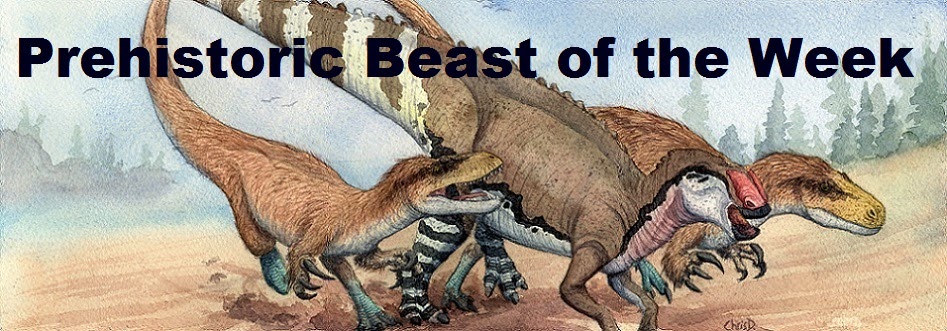
This week belongs to a mysterious theropod dinosaur. Check out Siats ! Siats was a large, meat-eating dinosaur that lived in what is now Utah, USA, during the middle Cretaceous period, about 98 million years ago. The individual found would have been about 30 feet (9 meters) long from snout to tail, but appeared to have been still growing when it died so it may have been able to grow larger. The genus name is after a terrifying man-eating monster from the local Ute tribe's mythology, called a siats.
 |
| Life reconstruction of what Siats may have looked (mostly based on other megaraptorans) like by Christopher DiPiazza. |
Unfortunately the known remains of Siats are only fragmentary, consisting of vertebrae, legs, and part of the pelvis, but enough for experts to identify it as a large theropod. Despite being large, the parts of the vertebra that were found were not fully fused, implying it was still a juvenile when it died, implying it could have gotten even larger!
When it was discovered, Siats was identified as being from the megaraptoran group of theropods. At the time megaraptorans were considered related to the group of meat-eating dinosaurs that includes Allosaurus and Acrocanthosaurus, called allosauroids. As time went on, however, and more megaraptoran fossils were found around the world, inlcuding a skull from South America, many experts reclassified them as being more closely related to the tyrannosauroid group of theropods, than the allosauroid group. Depending on the experts you ask, megaraptorans were either just outside the tyrannosaur group or within it but near the base. If this is true, Siats likely would have had a long narrow snout filled with proportionally small, curved teeth, and three-fingered hands with scythe-like claws.
Siats is an important fossil to our understanding of theropod evolution because we have so few fossils from the time period in which it lived, the middle Cretaceous. The fact that it was so large is also interesting, especially if it was indeed closely related to tyrannosaurs. It implies that a branch of (or close to) the tyrannosaur group grew to extremely large sizes all the way back during the middle Cretaceous. This would have been independent of the later group of extremely large tyrannosaurs, which includes T. rex, which didn't start to get large until millions of years later. In fact, there is even a small tyrannosauroid that lived alongside Siats, called Moros, that likely was part of the lineage that would produce this second group of giants.
 |
| Some of the bones unearthed belonging to Siats. |
Siats is an important fossil to our understanding of theropod evolution because we have so few fossils from the time period in which it lived, the middle Cretaceous. The fact that it was so large is also interesting, especially if it was indeed closely related to tyrannosaurs. It implies that a branch of (or close to) the tyrannosaur group grew to extremely large sizes all the way back during the middle Cretaceous. This would have been independent of the later group of extremely large tyrannosaurs, which includes T. rex, which didn't start to get large until millions of years later. In fact, there is even a small tyrannosauroid that lived alongside Siats, called Moros, that likely was part of the lineage that would produce this second group of giants.
Fossils from the middle Cretaceous are still rare, but other known dinosaurs that Siats would have lived alongside are its smaller relative, Moros, the large armored plant-eater, Peloroplites, as well as a number of giant long-necked sauropods.
References
Coria, Rodolfo A.; Currie, Philip J. (20 July 2016). "A New Megaraptoran Dinosaur (Dinosauria, Theropoda, Megaraptoridae) from the Late Cretaceous of Patagonia". PLOS ONE. 11 (7) e0157973.
Coria, Rodolfo A.; Currie, Philip J. (20 July 2016). "A New Megaraptoran Dinosaur (Dinosauria, Theropoda, Megaraptoridae) from the Late Cretaceous of Patagonia". PLOS ONE. 11 (7) e0157973.
Naish, Darren; Cau, Andrea (7 July 2022). "The osteology and affinities of Eotyrannus lengi, a tyrannosauroid theropod from the Wealden Supergroup of southern England". PeerJ. 10 e12727.
Porfiri, Juan D.; Novas, Fernando E.; Calvo, Jorge O.; Agnolín, Federico L.; Ezcurra, Martín D.; Cerda, Ignacio A. (1 September 2014). "Juvenile specimen of Megaraptor (Dinosauria, Theropoda) sheds light about tyrannosauroid radiation". Cretaceous Research. 51 (Supplement C): 35–55.
Zanno, L. E.; Makovicky, P. J. (2013). "Neovenatorid theropods are apex predators in the Late Cretaceous of North America". Nature Communications 4. doi:10.1038/ncomms3827.
