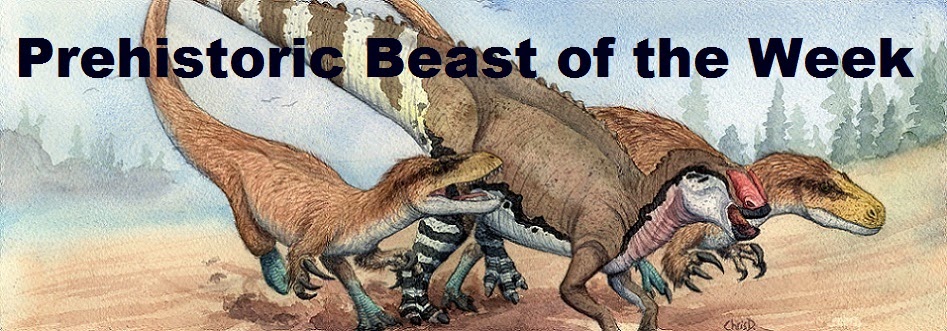
This week we are checking out a newly described predatory dinosaur with a truly frightening and fantastical name. Look out for Tromerosaurus solumons!
Tromerosaurus was a theropod dinosaur that lived in what is now Southern Alberta, Canada, during the late Cretaceous period, between 76 and 77 million years ago. It measured about 30 feet (7meters) from snout to tail and would have been a meat-eater when alive. It's genus name translates to "frightening lizard/reptile" and the species name to "lonely mountain". This is because the small horn (the "mountain" in question) just before its eye socket was isolated by a wider flat shelf of bone behind it. This is also in reference to the Lonely Mountain from the famous book by J.R.R. Tolkien, The Hobbit, where the dragon, Smaug, lived. (The venn diagram of Tolkien fans and paleontologists has a gigantic overlap section.)
.jpg) |
| Tromerosaurus life reconstruction in watercolors by Christopher DiPiazza. |
Tromerosaurus was a tyrannosaurid, meaning it was closely related to the famous Tyrannosaurus, and likewise had all the typical tyrannosaurid features, like having long, backwards-curved teeth on the sides of its jaws and smaller, narrow teeth in the front of the snout with "D" shaped cross sections. It had a bony crest running down the midline of its snout and around its eyes, plus small horns jutting out just before the eyes. It would have had proportionally small bust strong arms with two fingers on each hand and a hooked claw on each finger. Its feet were made up of three bones, called metatarsals, but the middle one was pinched between the outer two in an upside down "v" shape, present in all tyrannosaurs.
 |
| "Frighteing Lizard from the Lonely Mountain" is a nod to Smaug, the dragon, regardless of how pronounced this dinosaur's horns are. Cartoon by Christopher DiPiazza. |
Tromerosaurus is important because it helps paleontologists get a more detailed idea of how tyrannosaurs were evolving in North America during the late Cretaceous. Within its family it was most closely related to relatives, like Gorgosaurus and Albertosaurus, which are in an even more specific group, called the albertosaurines. Like them, Tromerosaurus had proportionally longer legs than what is typical for large theropods, implying it was a fast runner in life. That being said, Tromerosaurus also possessed traits in line with yet another branch in its family, called the tyrannosaurines, which includes T. rex itself and are characterized by being the largest and most robust of the tyrannosaurs. Like them, Tromerosaurus had a notably wide skull base, around where the jaw muscles would have been. This implies that despite its gracile body, it would have also had a powerful bite, even among tyrannosaurs!
 |
| Skull of Tromerosaurus, photo credit: Khoi Nguyen |
When alive Tromerosaurus would have been a top predator in its community. It wasn't the only one, however, and would have shared space with fellow tyrannosaur, Daspletosaurus, which was similar in size to it but slightly more heavily-built. Tromerosaurus also would have lived alongside many other dinosaurs, including the ornithomimid Struthiomimus, and hadrosaurs, Corythosaurus, and Maiasaura.(which it probably ate.)
References
Powers, Mark J.; Napoli, James G.; Coppock, Colton C.; Sharpe, Henry S.; Garros, Christiana W.; Demers-Potvin, Alexandre V.; Raun, Gorm S.; Stock, Jordan C.; Miyashita, Tetsuto; Currie, Philip J. (2026-10-02). "A new albertosaurine from the Oldman Formation, Alberta, Canada, illuminates ambiguity between albertosaurine and tyrannosaurine characteristics".

No comments:
Post a Comment