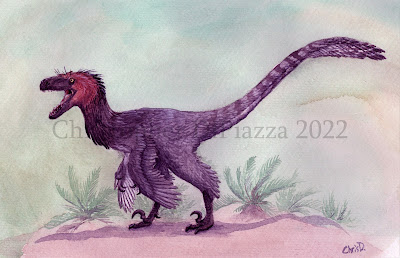
Sunday, July 3, 2022

Amargasaurus: Beast of the Week

This week we will be checking out a sauropod with a truly striking style!  Introducing Amargasaurus cazaui! 

Amargasaurus was a plant-eating dinosaur that lived in what is now Argentina during the early Cretaceous period, roughly 130 million years ago.  It measured about 33 feet (10 meters) long from snout to tail.  It's name translates to "Amarga reptile" in reference to La Amarga, the geological formation as well as the town near where this dinosaur's bones were discovered in Argentina.  "Amarga" in Spanish means "bitter". 

Watercolor reconstruction of Amargasaurus by Christopher DiPiazza

The most unique and striking feature about Amargasaurus is the fact that it had two rows of upward-facing spines down its neck and part of its back.  These spines were actually part of the animal's vertebrae!  The spines growing out of this dinosaur's neck were pointed and spike-like, but as they go further down the back, they become blunter and flatter.  Nobody is exactly sure what purpose these structures would have served in life.  However, many think they were most likely some sort of display adaptation within the species.  Reconstructions of these spines have varied over the years as scientists studied the fossils and came up with more updated ideas.  The oldest versions had skin connecting the spines, like a pair of fins running down the back.  Then it was argued they were more likely not covered in skin, but individually covered in keratin, forming a series of spikes.  The latest study from 2022 examined the spines more closely, finding that their texture and the growth rings in their cross section suggests that there were fibers connecting them in life, and they were likely covered in some sort of soft tissue, forming a sail-like structure.    

Amargasaurus skeletal mount.

Other interesting features about Amargasaurus is that it actually had a relatively shorter neck proportionally when compared to other sauropod dinosaurs.  Like its relatives, however, it likely possessed a set of teeth concentrated at the front of the mouth that were peg-shaped.  This is a good mechanism for raking leaves and other foliage off of branches while feeding. Only part of the skull was found, unfortunately.  This is common for sauropods with their big, bulky bodies and tiny, delicate heads that are easily destroyed during fossilization.

In 2014, a team of paleontologists actually scanned the inside of the part of Amargasaurus' skull that was found, which included the braincase.  They were able to see the space that would have held the dinosaur's inner ear canals, which would control the sense of balance.  The shape of the inner ears plus how the vertebra fit together suggest that Amargasaurus actually would have held its neck horizontally out in front, rather than upright, as sauropods are often imagined.  The head also would have also been oriented with the snout facing directly downwards.  This doesn't mean that Amargasaurus wasn't capable of moving its head and neck around in different poses depending on its behavior, of course, but rather a suggestion on its most comfortable default resting position.  

That's it for this week!  As always feel free to comment below!

References

Cerda, Ignacio A.; Novas, Fernando E.; Carballido, José Luis; Salgado, Leonardo (March 24, 2022). "Osteohistology of the hyperelongate hemispinous processes of Amargasaurus cazaui (Dinosauria: Sauropoda): Implications for soft tissue reconstruction and functional significance". Journal of Anatomy: joa.13659.

Novas, Fernando E. (2009). The age of dinosaurs in South America. Bloomington: Indiana University Press. ISBN 978-0-253-35289-7.

Paulina Carabajal, A.; Carballido, J.L.; Currie, P.J. (2014). "Braincase, neuroanatomy, and neck posture of Amargasaurus cazaui (Sauropoda, Dicraeosauridae) and its implications for understanding head posture in sauropods". Journal of Vertebrate Paleontology. 34 (4): 870–882.

Upchurch, P., Barrett, P.M, & Dodson, P. 2004. Sauropoda. In: Weishampel, D.B., Dodson, P., & Osmolska, H. (Eds.). The Dinosauria (2nd Edition). Berkeley: University of California Press. Pp. 259–322.

Sunday, June 12, 2022

Lystrosaurus: Beast of the Week

This week we'll be checking out a wildly successful animal who's lineage managed to make it through the most powerful mass extinction in earth's history.  Say hello to Lystrosaurus!

Lystrosaurus was a plant-eating synapsid (group of animals that includes, but isn't limited to modern mammals) that lived during the late Permian era and the early Triassic period, between 255 and 250 million years ago.  Several species within the genus have been identified and their fossils have been found in Antarctica, China, India, Russia, and South Africa.  Among the species known, their sizes range from less than a meter (about 2 feet) up to 2.5 meters (about 8 feet) long from beak to tail.  The genus name translates to "Shovel Reptile" in reference to the wide, flat beaks they possessed.  

Lystrosaurus murrayi lived during the early Triassic in what is now South Africa.  Watercolor reconstruction by Christopher DiPiazza.

Lystrosaurus was a member of the dicynodont group of synapsids.  Dicynodonts walked on all fours and are notable for having squat robust bodies, broad short beaks, and two downward facing tusks that grew from either side of their upper beak.  Other than these tusks, they had no other teeth in their short jaws.  Lystrosaurus had thick limb bones and would have stood and walked with a semi-sprawling gait, similar to some reptiles today.  It is thought that at least some species of Lystrosaurus were strong diggers and may have lived in burrows.  

You may have noticed that the areas Lystrosaurus have been discovered spans a wide range.  Keep in mind that during the time Lystrosaurus was alive, the continents we now today were actually attached in one "supercontinent", called Pangea.  In fact, it the existence of Pangea and the concept of the continents moving over millions of years, called plate tectonics, was proven partially thanks to the same species of Lystrosaurus fossils all of the same age being discovered in Africa, India, and China, which would have been connected at the time it was alive. (either that or a short-limbed creature adapted to digging swam across oceans...which definitely didn't happen.)

Lystrosaurus georgi lived during the early Triassic in what is now Russia.  Skeletal mount on display at Museums Victoria in Australia.

Perhaps most impressive about Lystrosaurus, was the fact that it was just so abundant in the ecosystems that it lived. Even more impressive, some species, like Lystrosaurus curvatus, from Africa, managed to survive though the mass extinction event at the end of the Permian Era, into the Triassic, 251 million years ago.  Considered the most powerful extinction in earth's history, this event resulted in over 70% of land vertebrates being wiped out.  It included largest volcanic eruptions in earth's history, with 2 million square km (770 square miles) of earth's surface being covered in lava, and tons of carbon dioxide released in the atmosphere, choking out any animals that weren't outright incinerated.  Once into the Triassic, the surviving Lystrosaurus kept flourishing, becoming some of the most common and widespread land vertebrates in the fossil record.  In some fossil sites from the early Triassic, Lystrosaurus bones make up 95% of all the vertebrate fossils present.

So how did this little synapsid manage to survive the nastiest extinction event in earth's history? Scientists have a few ideas.  One of which is Lystrosaurus' burrowing lifestyle, and how hiding underground may have allowed it to avoid being choked out by all the extra carbon dioxide released that killed other land animals.  Another clue is that by looking at growth rings in cross sections of Lystrosaurus tusks, paleontologists can tell that Lystrosaurus could go into a torpor state, like hibernation, possibly allowing them to literally sleep through the global catastrophe while other animals starved to death. 

When alive, Lystrosaurus, would have probably relied on hiding underground or in the underbrush to avoid predators.  It also may have been able to use its tusks to defend itself if it needed to.  The late Permian Lystrosaurus would have watched out for sabre-toothed gorgonopsids.  The Triassic species were probably preyed on by the crocodile-like rauisuchians, and even some of the first dinosaurs.

That's all for this week! Feel free to leave a question or comment below!

References

Botha, J. & Smith, R.M.H. (2005). "Lystrosaurus species composition across the Permo–Triassic boundary in the Karoo Basin of South Africa". Lethaia. 40 (2): 125–137.

Cluver, Michael Albert (1978). Fossil reptiles of the South African Karoo. The South African Museum.

Damiani, R. J.; Neveling, J.; Modesto, S.P. & Yates, A.M. (2004). "Barendskraal, a diverse amniote locality from the Lystrosaurus assemblage zone, Early Triassic of South Africa". Palaeontologia Africana. 39: 53–62.

Surkov, M.V.; Kalandadze, N.N. Of & Benton, M.J. (June 2005). "Lystrosaurus georgi, a dicynodont from the Lower Triassic of Russia" (PDF). Journal of Vertebrate Paleontology. 25 (2): 402–413.

Trewick, Steve (2016). "Plate Tectonics in Biogeography". International Encyclopedia of Geography: People, the Earth, Environment and Technology. John Wiley & Sons, Ltd. pp. 1–9.

Whitney, Megan R.; Sidor, Christian A. (27 August 2020). "Evidence of torpor in the tusks of Lystrosaurus from the Early Triassic of Antarctica". Communications Biology. 3 (1): 471.

Sunday, May 29, 2022

Pyroraptor: Beast of the Week

 This week we'll be checking out a mysterious little predator.  Say hello to Pyroraptor olympius!

Pyroraptor was a meat-eating dinosaur that lived in what is now Southern France and possibly other parts of Europe, including Northern Spain, during the late Cretaceous period, about 70.6 million years ago.  When alive it would have measured roughly 5 feet (1.5m) long from snout to tail.  The genus name translates to "Fire Thief" because its bones were discovered shortly after a forest fire it the area.  The species name is in reference to the mountain, Monte Olympe, near where it was found.  

Watercolor life reconstruction of Pyroraptor olympius by Christopher DiPiazza.

Pyroraptor is unfortunately only known from scant fossil material, including a few limb bones, a few teeth, and the second toe claw.  The teeth were curved, blade-like, and had serrations on both edges, an adaptation for slicing meat.  The second toe claw is was long and hook-shaped, probably for pinning down prey.  Despite not being much, this is still enough material to deduct that Pyroraptor was likely a kind of dromaeosaur, the bird-like predatory dinosaurs famous for having enlarged, retractable "killer claws" on the second digit of each foot. (Velociraptor and Deinonychus are the most famous examples of this family.)  Based on other, better-preserved dromaeosaur specimens, we can also deduct that Pyroraptor would have almost certainly been covered in feathers in life, including long wing feathers on the hands and arms.  

Photos of teeth assigned to Pyroraptor discovered in Spain from the 2015 paper by Angelica Torices et al.

The part of Europe that included Pyroraptor's habitat would have been a series of islands during the late Cretaceous.  The dinosaurs and other land animals that lived there likely would have been under different environmental pressures from those on the mainland, and therefore may have evolved differently.  Pyroraptor's smaller size may have been an adaptation for surviving on small islands since prey may have been have been more limited.  It also may have behaved differently, possibly using different hunting styles and exploiting different food sources compared to dromaeosaurs on the mainland.  We can only guess, but it's fun to think about!

References

Allain, R., and Taquet, P. (2000). "A new genus of Dromaeosauridae (Dinosauria, Theropoda) from the Upper Cretaceous of France." Journal of Vertebrate Paleontology, 20: 404-407. [June 27, 2000]

Csiki-Sava, Z.; Buffetaut, E.; Ősi, A.; Pereda-Suberbiola, X.; Brusatte, S.L. (2015). "Island life in the Cretaceous-faunal composition, biostratigraphy, evolution, and extinction of land-living vertebrates on the Late Cretaceous European archipelago". ZooKeys (469): 1–161.

Pei, Rui; Li, Quanguo; Meng, Qingjin; Gao, Ke-Qin; Norell, Mark A. (2014-12-22). "A New Specimen of Microraptor (Theropoda: Dromaeosauridae) from the Lower Cretaceous of Western Liaoning, China". American Museum Novitates (3821): 1–28.

Torices, Angelica. “Theropod Dinosaurs from the Upper Cretaceous of the South Pyrenees Basin of Spain.” Acta Palaeontologica Polonica, 2013, https://doi.org/10.4202/app.2012.0121.

Monday, March 28, 2022

Interview with Paleontologist: Natalia Jagielska

Natalia Jagielska is in her 3rd year of PhD study at University of Edinburgh. Specialising in Jurassic Pterosaurs. Prior to doctorate she worked on synchrotron scanning of avian fossils at University of Manchester. 

Question 1: What was your earliest sign of interest in paleontology that you can remember?

NJ: Watching Jurassic Park 3, I'd take a guess, I really liked the raptors. 

Question 2: Did you have anyone who served as a role model when you were younger? Do you still have any now?

NJ: Not really. I really looked up to Nikola Tesla, a working class East European with thick accent and eccentricities, making his way in the West. While loving pigeons.

Question 3: You primarily work with pterosaurs. Did you choose them or did they choose you. (in a sense) 

NJ: It was purely accidental. There was a PhD opening on research on Skye material, I worked on Skye Jurassic deposits in my undergraduate. Unlikely match. 


Question 4: Was there anything you did or learned as you were on your way to your current career that you feel got you to where you are? What sort of field experience, a class, networking with the right people, or possibly something different?

NJ: I did a lot of free volunteering and part time work in various sectors. I did teaching, museum outreach, museum curation, industrial petroleum research, NGO, anything that came my way. I regret it in hindsight, as I missed much on developing my private life & ruining work life balance. But boosted my CV allowing to be rather competitive even without research, palaeontology, field work portfolio. 

Question 5: What would your advice be to anyone trying to make a career in paleontology (or science in general)

NJ: Know what you're getting into. And be aware it's a competitive field, with more graduates than job positions. Keep your options open and don't fall into tunnel vision. 

Question 6: What was or is your favorite project so far?

NJ: Mapping of Lower Jurassic Skye I had to do for my undergraduate thesis. 

Question 7: Do you have a favorite destination when it comes to fossils? Why?

NJ: Regis, I just like working with strata that is fissile. And Dorset is nice. 

Natalia with the fossil of the pterosaur, Dearc, which was described by Natalia in Februrary of 2022.

Question 8: A popular image of paleontologists is that they are constantly out in the field digging up fossils, which is true sometimes What people don’t realize is that a lot of paleontology work is conducted in a lab as well. In your experience how much time have you spend in the lab and in the field? What do you prefer?

NJ:. It's 90% office desk or work at home on computer. Especially during the pandemic. 

Question 9: Are there any fossils you’d like to work with that you haven’t yet?

NJ: Elements from the from Karabastau Formation, which might be really unlikely given sociopolitical situation of things 

Question 10: Do you ever get criticized on any of your work? How do you handle it?

NJ: It's part of research. Depends on delivery of criticism. If it's constructive peer review, I take on board and value it greatly. If it's someone with too much free time and twitter, I doubt it's in goodwill. 

Question 11: A common idea is that paleontology is just a “for fun” science, with no real impact or noticeable effect that helps the world. Do you think paleontology has a bigger part to play to than this? How?

NJ: It's accessible. Visual. And resonates with general public more than any other research field. It's an excellent vehicle for science communication & magnet to get people into educational spaces, like museums. Especially kids. 


Question 12: Who was the first paleontologist you met? How was that interaction?

NJ: On my first lecture on palaeontology at University, Professor John Nudds. I asked about place for work experience in the field in Manchester. Palaeontologists are just people, it's weird holding them up on some pedestal. 

Question 13: What is your favorite prehistoric animal? Was it different when you were younger? 

NJ: Any Dromaeosaurid, then and now, they're like felines of the Mesozoic world and I love felines. 

Question 14: If you could use a time machine to go back and pick only one prehistoric animal to bring back from history and observe alive and in person, which would it be and why?

NJ: Vast majority of fauna isn't preserved well in fossil record. I'd get something that clearly does not have good potential of preserving & we have no record of it.

Question 15: Back to the time machine. This time you can go back to any place and time period and have a look at what the environment was really like. Which one would you pick and why?

NJ: Georgian & Victorian England. I just want to know what kind of person Darwin & Owen really were. And see Crystal Palace before it burned down. 

Question 16: Which is your favorite museum? Why?

NJ: I'm going to be extremely sad, and say Natural History Museum London. It's neogothic cathedral for natural world. You cannot get better than this. It's big, and free. 

Question 17: What hobbies do you have? (Don’t have to be paleo-related.)

NJ: I love city walking & architecture, it's like geology of the human age. I also love to build plane models in my spare time. And KTV (Chinese Karaoke), extreme cheese fest, but I love screaming over ABBA. 


Sunday, March 13, 2022

Atrociraptor: Beast of the Week

 This week we'll be covering a unique predator that will be makes its big screen debut in the movie, Jurassic World: Dominion.  Let's check out Atrociraptor marshalli!

Atrociraptor was a meat-eating dinosaur that lived in what is now Alberta, Canada, during the late Cretaceous period, about 68.5 million years ago.  It is estimated to have measured a little over 6 feet long (2 meters) from snout to tail when alive, but this is based on only some skull pieces and scaling them to more completely known relatives.  The genus name translates to "Atrocious Thief". 

Atrociraptor life reconstruction in watercolors. By Christopher DiPiazza

Atrociraptor was a member of the dromaeosaurid family of dinosaurs.  Dromaeosaurids were famous for being relatively small, relatively fast-moving predators with a long retractable claw on the second toe of each foot.  Deinonychus and Velociraptor are the two most famous members of this group.  There are many dromaeosaurids that were discovered possessing fossilized feathers or direct evidence of feathers, so it is almost certain that being feathered was a universal trait to this group, meaning Atrociraptor likely would have been feathered in life as well.  

Unfortunately Atrociraptor is only known from some skull material, specifically the tips of the upper and lower jaws, and teeth.  Based on this, however, scientists were still able to tell it was a dromaeosaurid by the size and number of serrations on the slightly curved, blade-like teeth, which are diagnostic to the family.  Atrociraptor's teeth weren't as curved as those of some other meat-eating dinosaurs, but they were arranged in the jaw so that the tips were dramatically angled to the back of the mouth, which would have helped the dinosaur get chunks of flesh down faster as it tore them off.  This also would prevent living prey from escaping if it was bitten.  Based on the actual jaws, Atrociraptor would have had an unusually short, but deep snout, which is in contrast to its relative, Velociraptor, known for having a particularly long, narrow one.  

Fossil specimen of Atrociraptor's jaws. (photo by Emily Willoughby)

Despite what is often portrayed in movies, we have no idea if Atrociraptor hunted in groups or alone in life.  Like many meat-eaters today, there is a chance it may have done a bit of both depending on what kind of prey was available.  We may never know for sure! 

Atrociraptor would have shared its habitat with other dinosaurs, like, Anodontosaurus, Hypacrosaurus, and Pachyrhinosaurus, Sphaerotholus?  It also would have been weary of the large tyrannosaurid, Albertosaurus.  

References

Currie, P. J. and D. J. Varricchio (2004). "A new dromaeosaurid from the Horseshoe Canyon Formation (Upper Cretaceous) of Alberta, Canada". Pp. 112–132 in P. J. Currie, E. B. Koppelhus, M. A. Shugar and J. L. Wright. (eds.), Feathered Dragons. Indianapolis: Indiana University Press.

Larson, D. W., Brinkman, D. B., & Bell, P. R. (2010). Faunal assemblages from the upper Horseshoe Canyon Formation, an early Maastrichtian cool-climate assemblage from Alberta, with special reference to the Albertosaurus sarcophagus bonebed This article is one of a series of papers published in this Special Issue on the theme Albertosaurus. Canadian Journal of Earth Sciences, 47(9), 1159-1181.

Lü, Junchang; Brusatte, Stephen L. (2015). "A large, short-armed, winged dromaeosaurid (Dinosauria: Theropoda) from the Early Cretaceous of China and its implications for feather evolution". Scientific Reports. 5: Article number 11775.

Turner, A.H.; Makovicky, P.J.; Norell, M.A. (2007). "Feather quill knobs in the dinosaur Velociraptor". Science. 317 (5845): 1721.

Xu, Xing; Zhou, Zhonghe; Wang, Xiaolin; Kuang, Xuewen; Zhang, Fucheng; Du, Xiangke (2003). "Four-winged dinosaurs from China". Nature. 421 (6921): 335–340.

Sunday, February 27, 2022

Dearc: Beast of the Week

 This week we'll be checking out a newly described pterosaur.  Make way for Dearc sciathanach!

Dearc (pronounced like jark)was a pterosaur that lived in what is now Scotland during the middle Jurassic period, about 166 million years ago.  The one skeleton found would have had a wingspan of about 8 feet (2.5 meters), but it's possible this taxa could have grown large in life, with wingspans of over 9 feet. (3 meters)  The genus and species name translate from Gaelic to "Flying Lizard". Like many of its relatives, Dearc, was almost certainly a meat-eater when alive, possibly preying on fish.

Watercolor life reconstruction of Dearc by Christopher DiPiazza.

Dearc is special for a few reasons.  It was a member of what is referred to as the rhamphorhynchoid group of pterosaurs, which flourished during the Triassic and Jurassic, but appeared to have gone extinct by the Cretaceous periods.  They are identified by having long, pointed teeth, proportionally short hind legs, and long narrow tails.  Dimorphodon is another example of a rhamphorhynchoid.  The other pattern about this group of pterosaurs is that they are overall smaller when compared to their cousins, the pterodactyloid pterosaurs. (like Pteranodon or Quetzalcoatlus) With this in mind, Dearc is particularly large for a rhamphorhynchoid, with a wingspan that was over eight feet or more given that  the individual specimen unearthed was still growing when it died!  

It is the most well-preserved pterosaur specimen to ever be discovered in the United Kingdom, known from an almost complete skull (missing the top of the head and top tip of the jaw, and almost the entire body.  Only the legs, some of the wing bones, and the tip of the tail are really missing.  This is amazing since pterosaurs, having such delicate bones, are not usually fossilized at all unless in really specific conditions, and when they are, they're usually either highly fragmentary or totally flattened to the point their bones are almost in two dimensions when found. Dearc, on the other hand's skull was so well preserved, that paleontologists were able to scan the inside of it and learn what the shape of its brain and inner ear cavities looked like!  Their findings suggest Dearc had a proportionally tiny brain, except for the optic lobes which were huge. This means Dearc would have had sharp eyesight when alive which makes sense for flying and searching for prey from the air.

Fossil of Dearc. photo from the paper describing the taxa by Natalia Jagielska. (listed below)

Dearc's environment would have been much warmer tan it is in Scotland today, and consisted of a series of small islands surrounded by shallow tidal seas.  Dearc may have used its sharp eyesight to hunt for food while flying in the air, possibly even plucking small fish or other animals from the surface of the water with its long, low skull, and extremely long, interlocking teeth.  I can also imagine it being an opportunistic feeder, going after any marine life stranded on sand bars during low tide.  Unfortunately not much is known about any of Dearc's neighbors since the fossil record of its time is still pretty scarce.  That being said dinosaur tracks, including those from stegosaurs, ornithopods, and theropods, were discovered near Dearc's skeleton from the same time, so it was definitely sharing space with large dinosaurs! 

References

dePolo, Paige E.; Brusatte, Stephen L.; Challands, Thomas J.; Foffa, Davide; Wilkinson, Mark; Clark, Neil D. L.; Hoad, Jon; Pereira, Paulo Victor Luiz Gomes da Costa; Ross, Dugald A.; Wade, Thomas J. (2020-03-11). Fiorillo, Anthony R. (ed.). "Novel track morphotypes from new tracksites indicate increased Middle Jurassic dinosaur diversity on the Isle of Skye, Scotland"

Natalia Jagielska; Michael O’Sullivan; Gregory F. Funston; et al. (February 2022). "A skeleton from the Middle Jurassic of Scotland illuminates an earlier origin of large pterosaurs". Current Biology. 32: 1–8.

Sunday, February 13, 2022

Troodontid (Alaskan): Beast of the Week

 This week we'll be checking out a unique member of the troodontid family of dinosaurs.  Let's check out the mysterious Alaskan troodontid!

The Alaskan troodontid was a likely mostly meat-eating dinosaur that lived in what is now Alaska, in North America, during the late Cretaceous period, about 69 million years ago.  From snout to tail it is estimated to have measured about 13 feet (4meters) long. 

This is the first dinosaur featured on Beast of the Week that doesn't have an official Genus and species name yet.  A formal scientific paper has yet to be published describing it, even though its known remains, consisting of teeth, are widely known.  

My life reconstruction in watercolors of a trio of the mysterious Alaskan troodontid.

Even though the fossil material is extremely scant, we know this dinosaur was almost certainly a member of the troodontid family of dinosaurs, like Pectinodon and Byronosaurus, because the fossilized teeth are curved and have extremely deep serrations, which is diagnostic for that group.  Troodontids were typically smaller, fast-running dinosaurs, that would have looked very similar to birds when alive.  What sets this Alaskan troodontid apart, however, is the fact that its teeth are much larger than those of its known relatives.  Using these teeth to predict the size of the rest of the animal, basing proportions off more completely known relatives, we end up with an unusually massive troodontid at about 13 feet long! To put it into perspective, Pectinodon, a more typically sized member of the family, was only about 6 feet long.  

The reasoning for this troodontid's large size is mostly a mystery.  Scientists predict it may have had something to do with its habitat, which if you might remember, was Alaska today.  During the late Cretaceous, Alaska wasn't as cold as it is now, but it was still significantly cooler for the time, compared to the rest of the world.  It also would have undergone long periods of darkness in the winter, just like it does today.  Perhaps having a larger body was an adaptation to the cold, since animals with larger bodies can retain body heat more easily.  On top of that, the Alaskan troodontid almost certainly had a coat of feathers that could have helped retain heat as well.  We can be fairly confident of this since we have fossils of other species of troodontid that preserved actual feathers and evidence of feathers.  

Skeletal mount on display at the Perot Museum in Texas.  Note the vast majority of this mount is guesswork based on other more completely known troodontids.

Like all known troodontids, this species likely would have had large forward-facing eyes, that would have allowed it to better hunt for small prey, possibly even at night.  We also know that troodontids had a strong sense of hearing thanks to enlarged middle ear cavities in their skulls.  At least some of them even had asymmetrically placed ears, an adaptation also present today in many owl species which allows them to better target moving prey in complete darkness or other situations where sight isn't an option.  

The Alaskan troodontid likely had long legs with a retractable toe, armed with a curved claw, on each foot.  This would have been an adaptation ideal for pinning down smaller prey, like mammals and possibly smaller/baby dinosaurs.  The teeth we know were serrated for slicing meat, although some have suggested troodontids may have supplemented their diet with plant material, too.  If this species was living in an environment that was cold and dark for months out of the year, food would have been scarcer, and more menu options would have been ideal anyway.  

When alive the Alaskan troodontid would have shared its habitat with the gigantic plant-eating dinosaur, Edmontosaurus, the ceratopsian, Pachyrhinosaurus, and it would needed to watch out for the tyrannosaurid, Nanuqsaurus.  

References

Castanhinha, R.; Mateus, O. (2006). "On the left-right asymmetry in dinosaurs". Journal of Vertebrate Paleontology. 26 (Supp. 3): 48A.

Currie, P. J. (1985). "Cranial anatomy of Stenonychosaurus inequalis (Saurischia, Theropoda) and its bearing on the origin of birds". Canadian Journal of Earth Sciences. 22 (11): 1643–1658.

Fiorillo, Anthony R.; Tykoski, Ronald S.; Currie, Philip J.; Mccarthy, Paul J.; Flaig, Peter (2009-03-12). "Description of two partial Troodon braincases from the Prince Creek Formation (Upper Cretaceous), North Slope Alaska". Journal of Vertebrate Paleontology. 29 (1): 178–187.