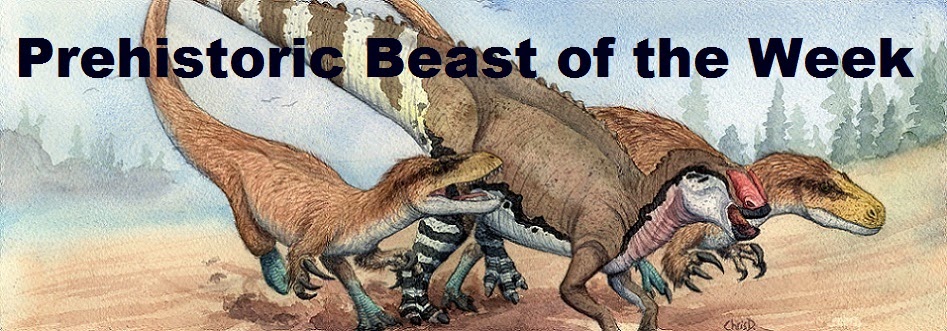
This week we will be checking out a huge dinosaur with an equally impressive name. Enter Sauroposeidon proteles!
Sauroposeidon was a sauropod dinosaur (long neck) that lived in what is now Oklahoma, Texas, and Wyoming, USA, during the early Cretaceous period, about 113 million years ago. Its genus name translates to "Lizard Earthquake God" after the Greek god, Poseidon, who in addition to his more famous association with the ocean, was also the god of earthquakes in Greek mythology. Since not a full skeleton is known, it is difficult to tell exactly how long this dinosaur could get (because necks and tails vary so much in sauropods) but estimates range anywhere between 89 to 112 feet (27-34 m) long, making it one of the largest land animals to ever exist.
 |
| Watercolor of two Sauroposeidon squaring up by Christopher DiPiazza. |
Sauroposaidon was originally known from only a few neck vertebra. That being said these neck vertebra were enormous, the longest of any dinosaur found in fact. Just one vertebra alone measured 4.6 feet (1.4m)! Later on more bones, including limbs, more vertebra, and even parts of the skull, which were originally referred to as their own genus, Paluxysaurus, were found to actually the same as Sauroposeidon. Probably the most interesting bit of information regarding this dinosaur's discovery is the fact that some of its limb bones were initially misidentified as fossilized tree trunks!
 |
| Photograph of three neck vertebra from Sauroposeidon. (Photo credit: Mathew Wedel) |
Sauroposeidon's neck bones were hollow, like those of a bird, and therefore extremely light for their immense size. This would allow the dinosaur to more easily move its head and neck around without exhausting itself. This was likely an adaptation for being able to reach leaves at the tops of trees to eat, but also could have been a way for the dinosaur to access a wide range of food without moving its body, thus conserving energy. Large sauropods, like Sauroposeidon, likely needed to be eating most of the time they were awake in order to fuel their bodies.
As an adult, Sauroposeidon likely had not predators to worry about. As a juvenile, however, it may have been preyed on by Acrocanthosaurus, and as babies, it would have needed to watch out for Deinonychus. It also coexisted with the tiny ceratopsian, Aquilops, and the long-tailed ornithopod, Tenontosaurus.
References
Rose, Peter J. (2007). "A new titanosauriform sauropod (Dinosauria: Saurischia) from the Early Cretaceous of central Texas and its phylogenetic relationships" (web pages). Palaeontologia Electronica. 10 (2).
Wedel, Mathew J.; Cifelli, R.L.; Sanders, R.K. (March 2000). "Sauroposeidon proteles, a new sauropod from the Early Cretaceous of Oklahoma" (PDF). Journal of Vertebrate Paleontology. 20 (1): 109–114.
Wedel, Mathew J.; Cifelli, R. L.; Sanders, R.. K. (2000). "Osteology, paleobiology, and relationships of the sauropod dinosaur Sauroposeidon" (PDF). Acta Palaeontologica Polonica. 45: 343–388.

No comments:
Post a Comment